
How To Strap A Lawn Mower To A Trailer?
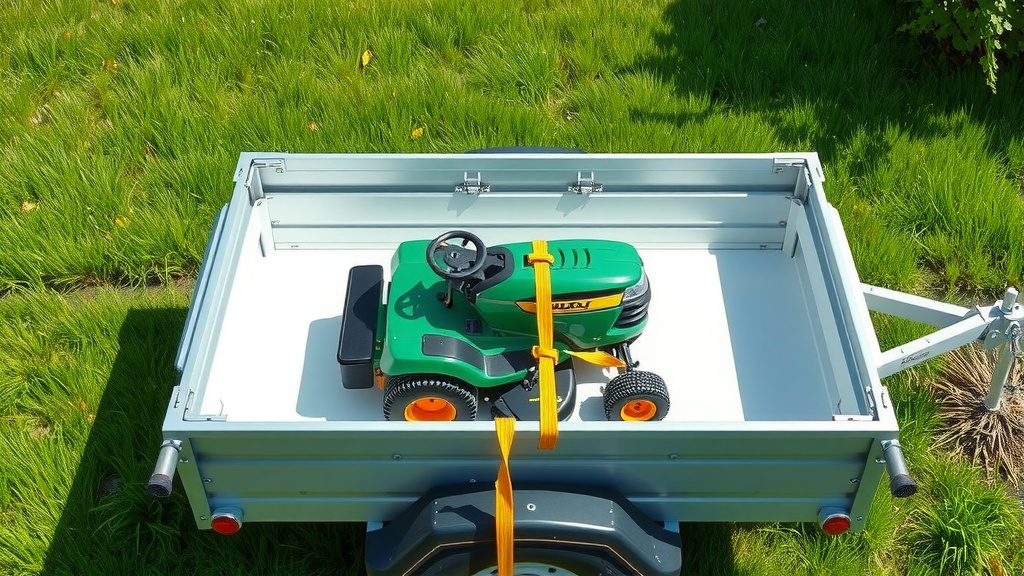
To safely strap a lawn mower to a trailer, first position it centrally for even weight distribution, then use at least four heavy-duty ratchet straps to secure each corner, ensuring the straps form opposing angles for maximum stability.
Always engage the mower’s parking brake and lower any cutting decks, then crisscross the straps from the mower’s frame to the trailer’s anchor points, checking for tightness before travel to prevent shifting.
Before you hit the road, here’s the quick scoop on securing your lawn mower:
- Always use heavy-duty ratchet straps – cheap bungee cords won’t cut it.
- Place your mower in the center of the trailer for balanced weight.
- Tie down your mower from at least four distinct points on its frame.
- Ensure straps are snug and cross them over for superior stability.
- Double-check everything before driving; a loose mower is a serious hazard.
How To Strap A Lawn Mower To A Trailer?
Securing a lawn mower to a trailer involves strategic placement, robust tie-downs, and careful checking to ensure it stays put during transit. You want to make sure your valuable equipment, and everyone on the road, remains safe.
Why Securing Your Mower is So Important
Imagine your mower coming loose on the highway. Scary, right? A properly secured mower isn’t just about protecting your investment; it’s about road safety for everyone. Unsecured loads can cause serious accidents, a fact often highlighted by traffic safety organizations (NHTSA).
You’re not just moving a machine; you’re handling heavy equipment. Taking the time to secure it correctly prevents costly damage, fines, and potentially tragic outcomes. Think of it as a small effort for a huge payoff in peace of mind.
Before You Load: Mower & Trailer Prep
A little preparation goes a long way. Before you even think about pushing your mower up the ramps, there are a few things to consider. These steps ensure a smoother and safer loading process.
Preparing Your Lawn Mower
First, clear the mower deck. Remove any loose items like grass bags, tools, or clippings. You don’t want anything flying off during transport. For riding mowers, lower the cutting deck to its lowest position. This provides a more stable profile.
Next, check your fuel level. It’s often best to run with a nearly empty tank, especially for longer trips, to minimize fire risk. Many experts recommend this practice for transporting fueled equipment. Finally, ensure the parking brake is engaged on riding mowers.
Inspecting Your Trailer
Is your trailer ready for the job? Check the tires for proper inflation and tread depth. Also, confirm that your trailer lights are working correctly. A quick glance at the hitch connection ensures it’s securely fastened to your vehicle.
Crucially, locate your trailer’s tie-down points. These are usually D-rings, stake pockets, or rails. Make sure they are strong, undamaged, and capable of holding significant weight. Weak anchor points are a big no-no.
Choosing the Right Straps: Don’t Skimp Here!
Your straps are the main event in keeping your mower secure. This is not the place for flimsy ropes or old bungee cords. We found that ratchet straps are your best friend for this task.
Understanding Strap Types
Ratchet straps offer superior tensioning power and hold compared to cam buckle straps. Look for straps with a working load limit that far exceeds the weight of your mower. As a general rule, many professionals recommend straps with a break strength of at least 3,000 lbs per strap.
While cam buckle straps are easier to use, they don’t provide the same positive lock or tension. They are typically better for lighter loads. For a heavy lawn mower, the firm grip of ratchet straps is essential.
Positioning Your Mower for Perfect Balance
Where you place your mower on the trailer matters more than you might think. Improper placement can lead to handling issues for your towing vehicle, or even sway. Think of it like balancing a seesaw.
Aim to position your mower so that its weight is distributed evenly over the trailer’s axles. For most trailers, this means placing the mower slightly forward of the axle line, but not so far forward that it puts excessive weight on the hitch. Generally, try to achieve about 10-15% of the total trailer weight on the hitch (SAE International guidelines often discuss similar principles for vehicle towing).
Tie-Down Points: Where to Attach Straps
You need to connect your straps to both the mower and the trailer. Choosing the right attachment points is key to preventing movement.
On the mower, look for sturdy frame members, axles, or dedicated tie-down loops if present. Avoid attaching straps to plastic components, steering wheels, or thin sheet metal. These simply won’t hold under pressure. On the trailer, use the D-rings or other designated anchor points.
Step-by-Step Strapping for Push Mowers
Even a push mower needs proper securing. It might seem lighter, but it can still shift and cause damage. Here’s a basic approach:
- Position the mower centrally on the trailer, facing forward.
- Engage the wheel brake if it has one.
- Attach the first ratchet strap to the front of the mower’s frame.
- Run the strap to a trailer anchor point, pulling it tight.
- Repeat for the other front side, forming a wide ‘V’ shape.
- Secure the rear of the mower with two more straps, again forming a ‘V’.
- Ensure all four straps are very snug.
Riding Mower & Zero-Turn Strapping Tips
These larger machines require even more attention due to their weight and bulk. The principle is similar, but with specific considerations.
Once loaded, engage the parking brake. Lower the deck completely. Then, use four heavy-duty ratchet straps. Attach two straps to the front axle or frame, pulling them forward and out to trailer anchor points. For the rear, attach two more straps to the rear axle or frame, pulling them backward and out. This creates a powerful crisscross effect, locking the mower in place.
Common Mistakes and How to Avoid Them
We’ve all seen a wobbly load before. These simple errors can have big consequences:
| Mistake | How to Avoid |
|---|---|
| Using bungee cords | Always opt for ratchet straps for heavy items. |
| Not enough straps | Use a minimum of four straps for any mower. |
| Loose straps | Pull straps very tight; they should feel taut with no slack. |
| Weak attachment points | Attach only to the mower’s frame or axles, and sturdy trailer points. |
| Poor weight distribution | Center the mower slightly forward of the trailer axles. |
Final Checks Before You Go
You’ve secured everything. Great! But before you hit the road, do a quick walk-around. This is your final chance to prevent issues. Give each strap a good tug. Is anything loose? Does the mower feel solid?
Many experienced haulers suggest stopping after the first few miles of driving to re-check all straps. Road vibrations can sometimes loosen things up. It’s a small pause that offers a huge safety benefit.
Quick Checklist for Safe Transport
Before leaving your driveway, run through this simple list:
- Mower deck lowered?
- Parking brake engaged?
- Fuel level checked?
- Four ratchet straps attached?
- Straps tight and crisscrossed?
- Trailer lights working?
- Tires properly inflated?
- Hitch secure?
Conclusion
Properly strapping a lawn mower to a trailer is not just a chore; it’s a commitment to safety. By following these practical steps – preparing your equipment, choosing the right straps, positioning it correctly, and performing thorough checks – you can ensure a smooth, worry-free transport. Taking a few extra minutes now can save you a lot of headache, and even danger, down the road.
FAQ: Can I use ropes instead of straps?
We found that ropes are generally not recommended for securing heavy equipment like lawn mowers. They can stretch, loosen, and are harder to tension effectively compared to ratchet straps. The risk of the load shifting is much higher with ropes.
FAQ: How many straps do I really need for a riding mower?
Many experts strongly recommend using a minimum of four heavy-duty ratchet straps for a riding mower. This provides robust anchoring at all four corners, preventing movement in any direction. Using fewer straps significantly increases the risk of instability.
FAQ: Should I drain the gas tank before transporting?
While not always strictly required for short distances, it’s a good safety practice to run the gas tank nearly empty or drain it if transporting over long distances or in very hot weather. This minimizes the risk of fuel leaks and reduces fire hazards (OSHA guidelines often address fuel safety in general transport).
FAQ: What if my trailer doesn’t have good tie-down points?
If your trailer lacks sturdy tie-down points, do not attempt to transport heavy equipment. It’s crucial to have secure anchor points on the trailer itself. Consider having professional D-rings or E-track systems installed for proper and safe securing.
FAQ: How often should I check my straps during a long trip?
For longer trips, it’s wise to pull over and re-check your straps every 50-100 miles, or whenever you stop for a break. Road vibrations and movement can cause straps to loosen over time, and a quick re-tightening can prevent serious issues.
