Drop Spreader vs Broadcast Spreader: Which to Choose? (November 2026)
Choose a drop spreader for precise placement near beds and edges, and a broadcast spreader for fast coverage of open lawn. In this broadcast spreader vs drop spreader comparison, your lawn shape and how close product can land to non-lawn areas decide the winner.
On this page (12 sections)
- Broadcast spreader vs drop spreader: the quick verdict
- The two spreader types side by side
- Placement precision: where drop spreaders win
- Coverage speed: where broadcast spreaders win
- How lawn shape changes the choice
- Capacity and refill stops
- Product type: seed, fertilizer, salt and compost
- Ease of use and setup
- Edges, driveways and sidewalks
- Even coverage and walking pace
- Who should buy which type
- Our broadcast spreader vs drop spreader verdict
Choose a drop spreader for precise placement near beds and edges, and a broadcast spreader for fast coverage of open lawn. In this broadcast spreader vs drop spreader comparison, your lawn shape and how close product can land to non-lawn areas decide the winner.
A drop spreader releases product straight down in a narrow pattern. A broadcast spreader spins or throws product outward in a wider pattern, so one pass covers more ground.
That difference drives everything else in this choice. Precision favors drop.
Speed favors broadcast. Lawn size, obstacles and product type decide how much each factor matters for you.
Our score weighs specs, features and buyer feedback against what you're shopping for. We compared the models below on capacity, pattern width, ease of use and the jobs each one handles best.
 Best for most home lawns
Scotts Turf Builder EdgeGuard DLX Broadcast Spreader
Broadcast spreader vs drop spreader: the quick verdict
Drop wins on placement control. Broadcast wins on coverage speed.
Pick the pattern that matches your lawn layout before you look at capacity or brand.
If your lawn is open and rectangular, a broadcast spreader will finish in fewer passes. If your lawn has narrow strips, beds, gardens or driveways close to grass, a drop spreader keeps more product where you want it.
Neither type is better for every yard. The right choice depends on whether your main problem is covering a large area fast or keeping product off everything that is not grass.
The two spreader types side by side
A drop spreader drops product below the hopper. A broadcast spreader throws product outward from a spinner.
That single mechanical difference explains the trade-offs in the table below.
| Factor | Drop spreader | Broadcast spreader |
|---|---|---|
| Pattern | Narrow line below the hopper | Wide fan from a spinner |
| Placement near edges | Strong control | Wider scatter, side shield helps |
| Coverage speed | Slower, more passes | Faster, fewer passes |
| Best lawn shape | Narrow strips and edged areas | Open, wide areas |
| Typical jobs | Fertilizer and seed in tight lines | Fertilizer, seed, salt and ice melt over open ground |
| Product | Best for | Capacity | Item dimensions | Item weight | Our score |
|---|---|---|---|---|---|
| Scotts Turf Builder EdgeGuard DLX Broadcast Spreader | most home lawns | 15,000 sq.ft. | 19 x 22 x 22 inches | 10.9 pounds | 9.7 |
| Agri-Fab Pull Behind Broadcast Spreader for Seed | large lawns | 130 pounds | 9.6 | ||
| Scotts Whirl Hand-Powered Spreader | small yards | 1,500 sq. ft. | 13 x 8.7 x 8.5 inches | 9.5 | |
| Landzie Compost Spreader 24 Inch | compost and topsoil | 23 pounds | 9.2 |
For a wider view of types, sizes and features, our fertilizer spreader guide explains how capacity and pattern width affect your work.
Placement precision: where drop spreaders win
Drop spreaders place product in a narrow line, so less lands on beds, paths and driveways. That control matters most where grass sits right next to something you do not want to treat.
Broadcast spreaders throw product outward. Even with a side shield, some product can land beyond the grass edge if you walk too close or set the rate too high.
The Scotts Turf Builder EdgeGuard DLX Broadcast Spreader uses EdgeGuard Technology to block the right side of the pattern. Scotts says this keeps product off landscaping, driveways and sidewalks when the shield is engaged.
That shield helps, but it does not turn a broadcast spreader into a drop spreader. The pattern is still wider than a drop line, and you still need to plan your passes around edges.
If precision is your top concern, our guide to a drop spreader for lawn helps you match width and hopper size to narrow areas.
Coverage speed: where broadcast spreaders win
Broadcast spreaders cover more ground per pass, so open lawns get done faster. Compare broadcast fertilizer spreaders for models suited to lawn treatments.
A wider pattern means fewer laps, fewer turns and less time pushing or carrying product.
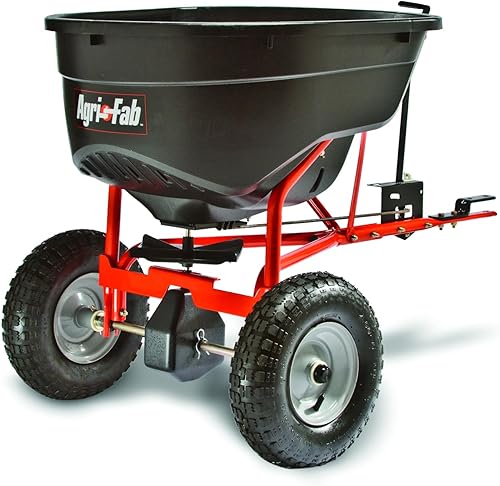
The Agri-Fab Pull Behind Broadcast Spreader for Seed spreads 10 ft to 12 ft wide. Agri-Fab says its 130 lb hopper covers up to 1/2 acre or 25,000 sq ft per fill, which reduces refill stops on large properties.
A drop spreader on the same lawn would need many more passes to cover the same width. On a large open yard, that extra time adds up fast.
Speed is not only about pattern width. Hopper capacity matters too, because every refill break slows you down.
A larger hopper lets you keep moving across open ground.
The Scotts Whirl Hand-Powered Spreader shows the other end of the same trade-off. It holds up to 1,500 sq. ft. of product, so it suits small yards where speed matters less and control matters more.
How lawn shape changes the choice
Open rectangular lawns favor broadcast. Narrow or irregular lawns favor drop.
Measure your grass area and look at its edges before you pick a pattern type.
A wide front lawn with clear boundaries is easy to treat with a broadcast spreader. You can make straight passes, overlap slightly and finish quickly.
A lawn with dog runs, garden beds, play areas, side yards and strips between fences is harder. Each obstacle forces you to stop, turn or adjust, and a wide pattern can overshoot into areas you want to protect.
Drop spreaders handle those shapes more cleanly. You can follow edges and borders with a narrower line and avoid treating soil, mulch or pavement by mistake.
Our guide on how to use scotts fertilizer spreader walks through rate settings and steady walking pace for broadcast work on open lawns.
Capacity and refill stops
Larger hoppers mean fewer refills, but the right size depends on your lawn area. Too small and you stop often.
Too large and the spreader can feel heavy when full.
The Agri-Fab tow-behind holds 130 lb and covers up to 25,000 sq ft per fill. That suits large lawns where refills would otherwise break up your workflow.
The Scotts Turf Builder EdgeGuard DLX holds up to 15,000 sq. ft. of Scotts product. That covers most home lawns in one fill, which keeps a typical job simple.
The Scotts Whirl holds up to 1,500 sq. ft. of product. On a small yard that is plenty.
On a larger lawn it means frequent trips back to the bag.
Match capacity to the area you treat in one session. A hopper that covers your whole lawn in one fill is easier to use than one that runs empty halfway across.
Product type: seed, fertilizer, salt and compost
Most broadcast spreaders handle seed, fertilizer, salt and ice melt. Drop spreaders focus on granular products in a line.
Compost and topsoil need a different tool entirely.
The Scotts models listed here are made for seed, fertilizer, salt and ice melt. Compare broadcast spreaders for salt for winter walkway jobs.
The Agri-Fab is also made for those same all-season jobs, including lawn treatments.
Rate settings matter more than the spreader type alone. Set the rate from the product label, then keep your pace steady so coverage stays even across the lawn.
Landzie Compost Spreader 24 Inch is a different category. It rolls compost, peat moss and topsoil through a 24 inch metal mesh basket, which is not the same as spreading granules.
Do not use a compost roller as a substitute for a granular spreader, or vice versa. Match the tool to the material, and your coverage will be more even.
Ease of use and setup
Walk-behind broadcast spreaders are simple to set up. Tow-behind models need a tractor or riding mower.
Hand-held models need no setup at all.
The Scotts Turf Builder EdgeGuard DLX comes pre-calibrated and ready to use, with no assembly required. You set the rate control dial, pour product into the hopper and start spreading.
The Scotts Whirl is hand-powered and comes fully assembled. It suits small yards where you want to grab it and go, with an adjustable arm support for comfort.
The Agri-Fab has a universal hitch that connects to most riding lawn mowers and lawn tractors. See how to use a tow-behind spreader for setup and operation guidance.
You gain speed and capacity, but you need the right towing equipment and room to turn.
Drop spreaders are also walk-behind tools, and many owners find the narrow pattern intuitive. You simply walk the line where you want product to land.
Edges, driveways and sidewalks
This is the section that decides the choice for many buyers. If product lands on pavement, you waste money and may need to sweep or wash it off.
Drop spreaders keep product in a narrow line below the hopper. That makes them strong for strips along driveways, sidewalks and garden beds.
Broadcast spreaders need more planning near hard surfaces. Use a side shield when you can, leave a buffer pass by hand for the last strip, or switch to a drop spreader for those edges.
The EdgeGuard DLX blocks the right side of its pattern when engaged. That helps on one side, but you still need to manage the other side and your turning points.
Our step-by-step guide on how to use scotts drop spreader shows how to walk a straight line and keep product on the grass.
Even coverage and walking pace
Even coverage comes from a correct rate setting and a steady pace, not from the spreader type alone. Both drop and broadcast spreaders can leave stripes if you rush.
Mark your passes in your head before you start. Overlap slightly on broadcast work so gaps do not show up later as thin grass.
For broadcast spreaders, our guide on how to use a broadcast spreader evenly explains spacing, overlap and pace in more detail.
For small yards, the best broadcast spreader for small yards guide helps you balance control with capacity.
Walk at the same speed on every pass. Slowing down to turn, or speeding up on the return pass, can change how much product lands in each area.
Who should buy which type
Buy a drop spreader if precision near edges is your main concern. Buy a broadcast spreader if speed on open ground matters more.
Most buyers fit one of those two groups clearly.
Choose drop if your lawn is narrow, edged by beds, or mixed with paths and patios. You will accept more passes in exchange for better placement.
Choose broadcast if your lawn is open and large. You will finish faster and refill less often, especially with a larger hopper.
Choose a tow-behind broadcast spreader if you have a riding mower or tractor and a large property. The Agri-Fab suits that setup with its 10 ft to 12 ft pattern and 130 lb hopper.
Choose a hand-held broadcast spreader if your yard is small. The Scotts Whirl holds up to 1,500 sq. ft. and fits small yards where a full walk-behind may be more than you need.
Our score weighs specs, features and buyer feedback against what you're shopping for. The scores above reflect how well each model fits its main job, not a claim that one type beats the other for every lawn.
Our broadcast spreader vs drop spreader verdict
Pick drop for narrow, edged lawns and broadcast for open, large lawns. In this drop spreader vs broadcast spreader decision, lawn layout matters more than brand preference.
If you remember one rule, match the pattern to the shape of your grass. Wide pattern for open ground.
Narrow line for tight spots.
For most home lawns that are open in the middle with beds on the sides, a broadcast spreader with a side shield plus a drop spreader for edges can cover both needs. That combo costs more, but it solves both problems.
Check your lawn area, your edges and the products you plan to use before you buy. Then choose the spreader that makes the job you do most often easier.
Frequently asked questions
Is a drop spreader or a broadcast spreader better for edges?
A drop spreader is better for edges because it places product in a narrower line directly below the hopper. A broadcast spreader throws product in a wider pattern, though a side shield setting can reduce spread on one side near beds and driveways.
Which is faster, a drop spreader or a broadcast spreader?
A broadcast spreader is faster on open lawn because one pass covers a wider area. A drop spreader covers a narrower strip per pass, so large open areas take more passes and more time to finish the same lawn.
Can I use a broadcast spreader for seed and fertilizer?
Yes, many broadcast spreaders are made for seed, fertilizer, salt and ice melt. Check the rate setting on the product you use, fill the hopper to the recommended level, and walk at a steady pace for even coverage.
When should I choose a drop spreader instead?
Choose a drop spreader when product must stay in a narrow line, such as between flower beds, along a sidewalk or in a strip of grass between hard surfaces. The tighter pattern helps you avoid wasting product on pavement.


