How to Choose a Leaf Blower: Complete Guide
To choose a leaf blower, match the power source and format to your yard size, leaf type and cleanup time. Pick corded electric for small, close to an outlet yards, battery for cord-free mid-size yards, and gas backpack models for large or heavy leaf loads.
On this page (12 sections)
- Which power source should you choose first?
- How to choose a leaf blower for your yard size?
- What are the best backpack blowers for large or heavy loads?
- Which leaf blower to buy for small yards and decks?
- What specs matter most: CFM, MPH or force?
- What is a good CFM for a leaf blower?
- How to buy a leaf blower based on features you will use?
- Battery, corded or gas: which do you buy for quiet use and upkeep?
- How to buy a leaf blower for wet leaves, pine needles and grass clippings?
- How to choose leaf blower format: handheld, backpack or wheeled?
- What else should you check before you buy?
- How to choose a leaf blower: your decision checklist
To choose a leaf blower, match power source, format and air power to your yard and leaf load. This guide explains how to choose a leaf blower for first time buyers, including corded, battery and gas options, handheld and backpack formats, and the specs that matter.
You do not need the strongest blower on the market for every yard. A light blower that you will use often beats a powerful model that stays in the shed.
Start with your yard size, leaf type and storage space, then narrow the list.
Our score weighs specs, features and buyer feedback against what you're shopping for. We compared the models below using those factors, and we checked the specs for airflow, speed, weight and controls.
Which power source should you choose first?
Choose the power source based on yard size, outlet access and runtime needs. Corded electric fits small yards near an outlet, battery fits mid-size yards where a cord is a nuisance, and gas fits large yards or heavy loads.
Corded electric blowers plug into a wall outlet and run as long as the cord reaches. They avoid charging and fuel mixing, and they often weigh less than gas models.
Their limit is range, because you can only work where the cord lets you go.
Battery blowers free you from cords and fuel, and they start with a trigger pull. For model-specific steps, see EGO blower instructions.
Runtime depends on the battery, speed setting and leaf load. If you want to collect debris instead, read cordless leaf vacuums.
If you own other battery tools on the same platform, an extra battery can extend your cleanup time.
Gas blowers offer long runtime and strong air power for large yards. They need fuel mixing for 2-cycle engines, plus seasonal storage and maintenance.
Backpack gas models also concentrate more power in a unit you wear, which suits long sessions. For a handheld battery example, see the EGO LB6151 blower review.
Our battery vs gas leaf blower guide compares runtime, power and upkeep in more detail. Read it before you decide if you are torn between those two options.
How to choose a leaf blower for your yard size?
Base your choice on how far you must walk and how much debris you must move. Small, simple yards need less power and less runtime, while large yards need more air volume and better weight distribution.
For a small yard with a patio, driveway and a few trees, a handheld blower is often enough. You can clear corners, steps and flower beds in short passes.
A corded model works well here because the distance from the outlet stays short.
For a mid-size yard with several trees, a battery handheld blower gives you freedom to move around garden beds and fences. You avoid dragging a cord across wet grass or catching it on shrubs.
Carry a spare battery if your yard takes a long session.
For a large yard, a backpack blower spreads weight across your back, shoulders and hips. That matters when you walk and sweep for 30 minutes or more.
Gas backpack models also deliver high CFM for moving large piles across long distances.
Think about leaf type as well as size. Dry, loose leaves move with modest air power.
Wet oak leaves, pine needles and grass clippings need more volume and force. For a blower with vacuum mode, see leaf blower vacuum use.
Our how to use leaf blower on lawn guide covers sweeping technique for different surfaces.
What are the best backpack blowers for large or heavy loads?
The best backpack blowers combine high CFM, high MPH and a harness that spreads the load. Look for padded straps, a hip belt, tube controls and low vibration features for long sessions.
A backpack format keeps the motor and fuel tank on your back instead of in your hand. Your arm guides only the tube, so you can sweep side to side with less fatigue.
That design helps when you clear a long driveway, a wooded lot or a large lawn after leaf drop.
Backpack blowers are not always right for small yards. You must put on the harness, adjust straps and carry the full weight of the unit.
If your cleanup takes five minutes, a handheld model may feel faster and simpler.
Check total weight before you buy. A backpack blower can weigh more than 20 lb, and you carry that weight for the whole job.
A padded harness and hip belt help, but they do not make the weight disappear.
Our Is a Backpack Leaf Blower Worth It? guide explains when the format pays off. It also covers shoulder comfort, storage space and the learning curve for new users.
A backpack example for large yards
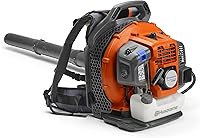
The Husqvarna 350BT Gas Leaf Blower is a 50.2-cc, 2.1-HP 2-cycle backpack model with 692 CFM, 180 MPH and 21 N of blowing force. Husqvarna says the X-Torq engine reduces emissions by up to 60% and increases fuel efficiency by up to 20%.
The ergonomic harness system includes a padded harness, hip belt and weight-leveling load management. Husqvarna says the adjustable offset handle helps prevent your arm from being pulled downward during use.
The blower weighs 22 lb and measures 14 in L x 18 in W x 11 in H. That size suits homeowners with larger properties, and it needs clear storage space in a garage or shed.
LowVib technology reduces vibration, and an air purge system removes air from the carburetor and fuel system to help starting. Cruise control and tube-mounted throttle controls let you set speed without reaching back to the engine.
Choose it for large yards, heavy leaf loads and long cleanup sessions. Skip it if you have a small yard, limited storage or a concern about carrying 22 lb on your back.
Which leaf blower to buy for small yards and decks?
For small yards, buy a lightweight handheld blower that you can carry comfortably for short jobs. Weight and control matter more than maximum power when you clear a deck, patio or short driveway.
A handheld blower lets you reach under railings, along fences and around planters. For gutter cleanup, compare leaf blower gutter attachments.
You can point the tube with one hand and adjust speed as you move from leaves to light debris.
That control helps on hard surfaces where you want leaves to move in a line, not scatter.
Corded electric models suit small yards because you plug in and start. They avoid battery charging and fuel storage, and they often weigh less than gas models.
The cord is the main trade-off, so plan your route to keep it behind you.
Battery handheld models add freedom when an outlet is far from the yard. They work well for garden beds, side yards and yards with obstacles.
Runtime varies with speed, so use a lower speed for light leaves and reserve high speed for piles.
Our best handheld leaf blower roundup compares more handheld options by weight and power. It helps if you prefer one-hand control over a backpack harness.
A corded handheld example for light cleanup
The BLACK+DECKER LB700 is a 7-amp corded electric handheld blower that moves air at up to 180 MPH and 180 CFM. It weighs 4.4 lb and includes the blower and one blow tube.
BLACK+DECKER says it is ideal for clearing debris from lawns, driveways, sidewalks and decks. Built-in cord retention helps prevent the cord from pulling loose during cleanup.
The tube attaches to the handheld body, and the corded design means you manage the cord as you work. That set-up favors small to mid-size areas near an outlet, not a large wooded lot.
Choose it for decks, driveways and small lawns where you can reach an outlet. Skip it if your yard is large, your outlet is far away or you want cord-free movement.
What specs matter most: CFM, MPH or force?
Look at CFM for air volume, MPH for air speed and newtons for blowing force together. No single number tells the whole story, because each spec describes a different part of how air moves debris.
CFM means cubic feet per minute, or how much air volume the blower moves. Higher CFM helps move large piles of dry leaves across a lawn or driveway.
It also helps when leaves are spread over a wide area.
MPH means miles per hour, or how fast the air leaves the tube. Higher MPH helps lift wet leaves, pine needles and debris stuck to grass.
It can also scatter light debris if you use full speed in tight spaces.
Blowing force, measured in newtons, combines volume and speed into one push measurement. Higher force can move wet or heavy debris more effectively.
Some makers publish force, while others publish only CFM and MPH.
Our leaf blower cfm vs mph guide explains when each spec matters more. Read it if two models look similar on paper but feel different in use.
What is a good CFM for a leaf blower?
A good CFM depends on leaf load, yard size and surface type. Light cleanup needs less volume, while large piles and wet leaves need more air moving through the tube.
For a patio, deck or small driveway, a lower CFM can still work because the area is small and the debris is close to a border. You move leaves in short passes and collect them with a rake or tarp.
For a mid-size lawn with several trees, mid-range CFM gives you enough volume to move piles without constant repositioning. You can push leaves toward a central spot, then move the pile in larger sections.
For a large yard, high CFM helps you move bulk material before it spreads out. Backpack gas models often sit at the top of the CFM range, which suits long driveways and wooded lots.
Our what is a good cfm for a leaf blower guide breaks down CFM bands by yard size. Use it to set a minimum CFM before you compare prices or formats.
How to buy a leaf blower based on features you will use?
Focus on features that affect comfort, control and storage on every use. A feature you use each time matters more than a feature you may never touch.
Tube-mounted throttle controls let you change speed without reaching for the engine. That helps when you move from wet leaves on grass to light debris on a deck.
Cruise control can hold a speed during long passes.
Low vibration systems reduce the buzz that travels into your hands and arms. They do not remove all vibration, but they can make a long session more comfortable.
Weight distribution matters just as much, especially on backpack models.
Cord retention on corded models keeps the cord from disconnecting. That small feature prevents a common interruption during cleanup.
Check similar details, such as an offset handle or padded grip, before you decide.
Attachments can extend what a blower can do, from gutters to hard-to-reach corners. Our best leaf blower attachments guide covers common add-ons and when they are worth buying.
Battery, corded or gas: which do you buy for quiet use and upkeep?
Choose by noise tolerance, runtime and maintenance you will actually do. Battery and corded models are simpler for many homeowners, while gas models suit larger yards and longer sessions.
Battery blowers start fast and avoid fuel mixing. They still need charging, and runtime drops at high speed or under heavy load.
If you already own tools on the same battery platform, that can simplify storage and charging.
Corded electric blowers avoid batteries and fuel entirely. They run as long as power is connected, which suits small yards near an outlet.
Cord management becomes part of the job, so keep the cord behind you and away from wet areas.
Gas blowers need fuel, oil mixing for 2-cycle engines and seasonal care. They offer strong power and long runtime for large properties.
Husqvarna says the 350BT has cruise control, an air purge system for starting and LowVib technology for comfort.
Our best quiet leaf blower roundup helps if noise is a priority. It compares lower-noise options for patios, decks and yards near neighbors.
How to buy a leaf blower for wet leaves, pine needles and grass clippings?
Buy for air speed and force when debris is wet, matted or stuck. Dry leaves slide easily, but wet leaves cling to grass and pine needles wedge into tight spots.
Wet leaves weigh more and stick to the lawn. You need enough MPH to lift them and enough CFM to keep them moving.
Use short, overlapping passes and push leaves toward a dry area or hard surface where they break free.
Pine needles are light but slippery. They need a steady stream of air rather than blasts that scatter them.
A variable speed control helps you start low, then increase power as needles gather into a pile.
Grass clippings and hedge trimmings are heavier and wetter than dry leaves. A stronger blower moves them in bulk, but you may still need a rake for matted areas.
Our best heavy duty leaf blower roundup lists models aimed at heavy debris.
A blower and a vacuum do different jobs. Our leaf blower vs leaf vacuum guide explains when blowing is enough and when collection matters.
It also covers combo units that blow and vacuum in one tool.
How to choose leaf blower format: handheld, backpack or wheeled?
Pick the format based on session length, weight comfort and storage space. Handheld is simplest for short jobs, backpack spreads weight for long jobs, and wheeled models suit large, flat areas.
Handheld blowers are light and easy to store. You can hang or shelf them in a small garage.
Some handheld gas models exist, and our best handheld gas leaf blower roundup covers that format for buyers who want gas power in a smaller unit.
Backpack blowers move the weight to your back and shoulders. They often deliver higher CFM and MPH, which helps on large yards.
They need more storage space and a harness adjustment before each use.
Corded handheld models sit in their own niche. Our best corded electric leaf blower roundup covers that format for small yards near an outlet.
Weight, cord retention and tube control are key there.
Lightweight handheld models are also worth a look if arm fatigue is a concern. Our best lightweight leaf blower roundup focuses on models that are easier to carry for short sessions.
Battery handheld models vary widely in power. Our best leaf blower cordless roundup compares cordless options by runtime and air power.
It also helps you see how battery size affects weight.
What else should you check before you buy?
Check weight, noise, included parts and storage before you pay. Those details decide whether you will use the blower often or leave it unused.
Weigh the blower in your hands if you can, or compare listed weights across models. A few pounds makes a big difference after 20 minutes.
Backpack models need special attention because you carry the full unit plus fuel or battery.
Check what is included in the box. The BLACK+DECKER LB700 includes the blower and one blow tube, and it does not include a cord.
The Husqvarna 350BT includes the backpack blower, and Husqvarna describes a 2-year warranty.
Storage size matters in small sheds and garages. A backpack blower needs room for the harness and tube, while a handheld model fits in a corner.
Measure your storage space before you choose a format.
Batteries and chargers are separate decisions for cordless models. Our best cordless leaf blower with battery and charger guide covers kits that include power storage.
It also explains why a bare tool may cost less upfront but need extra purchases.
Replacement batteries matter if you plan to keep a cordless blower for years. Our best leaf blower battery replacement guide covers battery options and platform fit.
Check compatibility before you order a spare.
Some buyers plan to mulch leaves after blowing. Our best leaf blower vacuum mulcher roundup covers combo tools for that job.
Our leaf mulcher or shredder guide explains dedicated mulchers for garden use.
Large properties sometimes need commercial-grade collection equipment. Our leaf vacuum commercial guide covers that step for larger cleanup jobs.
It helps you decide if a blower alone is enough.
Gas backpack models form another specific group. Our best gas leaf blower backpack roundup compares those models by power and harness design.
It is a good next step if the Husqvarna 350BT format fits your yard.
How to choose a leaf blower: your decision checklist
Use this checklist to turn yard size, leaf load and comfort needs into a short list. Answer each question, then match the answers to power source, format and specs.
Start with yard size and outlet access. Small and close to an outlet points to corded electric.
Mid-size with obstacles points to battery handheld. Large or heavy points to gas backpack.
Next, check leaf type. Dry leaves need moderate air power.
Wet leaves, pine needles and grass clippings need higher MPH, higher CFM or higher force. A backpack model helps when you must move bulk material over distance.
Then check session length and comfort. Short sessions favor handheld models.
Long sessions favor a backpack harness with padded straps and a hip belt. Low vibration features help on any format.
Finally, check storage and upkeep. Handheld models fit small spaces.
Gas models need fuel storage and seasonal care. Battery models need charging space and possibly a spare battery.
Pick corded electric if your yard is small and near an outlet. Pick battery if you want cord-free control for a mid-size yard.
Pick gas backpack if you have a large yard, heavy leaves or long cleanup sessions.
The Husqvarna 350BT suits large yards where a backpack harness and high CFM matter. The BLACK+DECKER LB700 suits small yards and decks where a light corded handheld blower is enough.
Small accessories still have a place in yard care, even though they do not power a blower. These AAA alkaline batteries suit flashlights, clocks, game controllers, toys and digital cameras, with a 10-year shelf life for emergency storage.
Keep batteries in a dry place and replace them as needed in small devices around the home. They are single-use alkaline batteries, not rechargeable cells for a cordless blower.
That brings us back to the core rule for how to choose a leaf blower: buy the format and power source you will use often, not the one with the largest spec numbers. Match the blower to your yard, and cleanup gets faster each time.
Frequently asked questions
What should first time buyers look for when they buy a leaf blower?
Start with yard size, outlet access, leaf type and cleanup time. Small yards near an outlet often suit corded electric models.
Larger yards may suit battery or gas models.
Format matters too, since handheld blowers are lighter while backpack blowers spread weight across your shoulders and hips.
How to buy a leaf blower for wet leaves?
Wet leaves weigh more and stick to grass, so you need stronger air movement and more blowing force. Look at CFM for volume, MPH for speed and newtons for force where available.
A backpack gas model can help on larger yards, while a handheld model may be enough for a small patio.
Which leaf blower to buy for a small yard?
For a small yard, a lightweight handheld blower is often the simplest choice. Corded electric models avoid battery runtime limits and cost less to run.
Check weight, cord length and tube control before you buy, since you will carry the blower for the whole cleanup.
What are the best backpack blowers for large yards?
The best backpack blowers combine strong CFM and MPH with a harness that spreads weight. Look for padded straps, a hip belt and controls on the tube.
Backpack models weigh more in total, but the load sits on your shoulders instead of your arm.
Check total weight before you choose.