9 Best Lawn Mower Blade Sharpeners (October 2026)
The best lawn mower blade sharpeners include the SHARPAL 103N All-in-1 Knife Garden Tool Lawn for hand sharpening, the Sharp Pebble Cordless Lawn Mower Blade Sharpener for cordless touch-ups, and the SporGain [Updated] Lawn Mower Blade Sharpener 15°-45° for adjustable angle-grinder guidance.
On this page (5 sections)
The best lawn mower blade sharpener for most homeowners is the SHARPAL 103N, a hand tool with several sharpening parts for mower blades and other garden tools. Choose a cordless tool for routine touch-ups, a jig if you own an angle grinder, or a bench machine for a dedicated setup.
A sharp edge helps the blade cut grass cleanly, but the right sharpener depends on the blade's condition and how often you mow. We compared manual tools, drill attachments, angle grinder jigs and powered machines by their stated features and fit for common maintenance needs.
For the sharpening process itself, see How to Sharpen Lawn Mower Blades?. If you are new to the task, our guide to How To Use Lawn Mower Sharpener? covers tool handling and setup.
Our picks at a glance
-
1
 Best for hand sharpening
SHARPAL 103N All-in-1 Knife Garden Tool Lawn
9.7/10 our score
See it on Amazon -
2
 Best for cordless touch-ups
Sharp Pebble Cordless Lawn Mower Blade Sharpener
9.6/10 our score
See it on Amazon -
3
 Best for adjustable angle-grinder guidance
SporGain [Updated] Lawn Mower Blade Sharpener 15°-45°
9.4/10 our score
See it on Amazon
- 4
 Check it
SporGain Lawn Mower Blade Sharpener
Best for a dedicated bench machine - 5
 Check it
UF-SHARP Diamond Lawn Mower Blade Sharpener
Best for a drill-powered compact tool - 6
 Check it
VEVOR Lawn Mower Blade Sharpener
Best for a larger grinding setup - 7
 Check it
SporGain Lawn Mower Blade Sharpener
Best for a workbench angle-grinder jig - 8
 Check it
Jinlida JLD20-9 Lawn Mower Blade Sharpener
Best for a 9-inch wheel and balancer - 9
 Check it
SporGain Updated Lawn Mower Blade Sharpener
Best for adjustable-speed guided grinding
Which lawn mower blade sharpeners suit different jobs?
The best lawn mower blade sharpener depends on whether you want hand control, a compact powered attachment, a guided jig or a dedicated grinding machine. The picks below are ordered by score, with each option matched to a specific maintenance need.
| Product | Best for | Sharpening method | Abrasives | Other uses | Our score |
|---|---|---|---|---|---|
| SHARPAL 103N All-in-1 Knife Garden Tool Lawn | hand sharpening | Handheld tool with slots and bars | Tungsten carbide and ceramic | Knives, pruners, loppers, shears, axes and more | 9.7 |
| Sharp Pebble Cordless Lawn Mower Blade Sharpener | cordless touch-ups | 9.6 | |||
| SporGain [Updated] Lawn Mower Blade Sharpener 15°-45° | adjustable angle-grinder guidance | Angle grinder jig | 9.4 | ||
| SporGain Lawn Mower Blade Sharpener | a dedicated bench machine | Powered bench machine | 8.9 | ||
| UF-SHARP Diamond Lawn Mower Blade Sharpener | a drill-powered compact tool | Electric drill attachment | 8.8 | ||
| VEVOR Lawn Mower Blade Sharpener | a larger grinding setup | Powered grinder | 8.7 | ||
| SporGain Lawn Mower Blade Sharpener | a workbench angle-grinder jig | Angle grinder jig | 8.5 | ||
| Jinlida JLD20-9 Lawn Mower Blade Sharpener | a 9-inch wheel and balancer | Powered bench grinder | 8.3 | ||
| SporGain Updated Lawn Mower Blade Sharpener | adjustable-speed guided grinding | Powered bench machine | 8.0 |
How we chose these lawn mower blade sharpeners
We compared the sharpening method, angle controls, blade compatibility, included accessories and setup needs described for each option. Our score weighs specs and features against what someone shopping for a lawn mower blade sharpener is likely to need.
SHARPAL 103N All-in-1 Knife Garden Tool Lawn: Best for hand sharpening
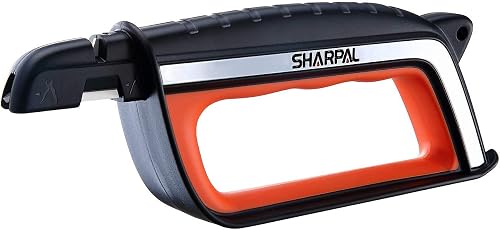
- Handheld multi-sharpener
- Three preset angle slots
- Tungsten carbide and ceramic bars
- Hand guard and rubber over-molded handle
A versatile hand tool for mower blades and other garden edges, with several sharpening parts and a protective hand guard.
Pros
- Three preset angle slots
- Works with single and double bevels
- Oversized handle fits gloved hands
Cons
- No blade holder or powered grinding wheel
- The angle slots are preset
The SHARPAL 103N is the most flexible hand tool in this group. It has three preset angle slots, a tungsten carbide bar and a ceramic bar, and it is designed for single and double beveled edges.
Its oversized handle and large hand guard help you keep your hand away from the blade edge. The rubber over-molded handle and base provide a secure grip, and the handle is sized to use with gloves.
This tool also suits a shed where pruners, hedge shears, axes and knives need attention. If your push mower stays there, compare push mower covers for outdoor protection.
It is less suited to a blade with significant damage because it has no powered grinding wheel or blade-holding fixture.
Choose it if you want one compact sharpener for several hand tools and mower blade touch-ups. If you'd rather use a machine, compare the powered choices below.
Sharp Pebble Cordless Lawn Mower Blade Sharpener: Best for cordless touch-ups
- Cordless sharpening kit
- Adjustable 20°–40° angle guide
- Variable speed from 5,000–30,000 RPM
- For standard residential blades
A cordless option for routine maintenance on standard residential blades. Deep dents, chips or missing metal call for a grinder first.
Pros
- Cord-free operation
- Adjustable angle guide
- Blade removal is optional for many standard residential blades
Cons
- Not intended for zero-turn or heavy-duty commercial blades
- One charge sharpens 1–2 standard residential blades
The Sharp Pebble cordless sharpener is designed for standard residential mower blades and routine touch-ups. Its adjustable angle guide spans 20°–40°, and its speed control ranges from 5,000 to 30,000 RPM.
The brand says blade removal is optional for many standard residential blades, though badly worn edges are best sharpened with the blade removed. One full charge is described as enough for 1–2 standard residential blades, so it is most useful for small maintenance sessions.
It is not intended for zero-turn or heavy-duty commercial blades that need higher torque. The brand also says this is a sharpener rather than a grinder, so a blade with chips, deep dents or missing metal needs a more substantial repair approach.
Pick this for cordless convenience and regular upkeep. For a deeper guide to this style, see our best electric mower blade sharpener roundup.
SporGain [Updated] Lawn Mower Blade Sharpener 15°-45°: Best for adjustable angle-grinder guidance
- Adjustable 15°–45° blade holder
- Fits 1.65–3.60 in blade widths
- Four adapter screws
- For most angle grinders
A workbench-mounted jig holds the blade and adjusts across a broad angle range. It suits buyers who already own a compatible angle grinder.
Pros
- Wide angle adjustment
- Blade holder fits several common blade styles
- Four adapter screws included
Cons
- Requires a separate angle grinder
- Needs workbench setup and adjustment
The SporGain adjustable jig is for people who already have an angle grinder and want help holding a blade at a repeatable angle. Its holder adjusts from 15° to 45° and fits blades from 1.65 to 3.60 in wide.
The jig is designed for standard straight, mulching and high-lift blades. Four adapter screws are included, and the manufacturer describes it as compatible with most angle grinders.
You need a stable workbench and some setup time before grinding. This approach gives more guidance than a loose hand-held grinder, but it still depends on using a separate grinder and securing the blade safely.
Choose it if angle control and compatibility with a grinder you own matter most. Our best mower blade sharpener for angle grinder page compares more options in this category.
SporGain Lawn Mower Blade Sharpener: Best for a dedicated bench machine
- Brushless motor with speed up to 3,000 RPM
- 30° and 45° blade guides
- 60-grit and 180-grit sanding discs
- For high-lift, low-lift, Gator and flat blades
A dedicated machine with adjustable speed and two blade guide angles. It is suited to regular sharpening when a bench setup makes sense.
Pros
- Brushless motor
- Two blade guide angles
- Includes coarse and fine sanding discs
Cons
- Requires bench space
- Its guides are limited to 30° and 45°
This SporGain machine is a dedicated option for sharpening mower blades on a bench. It has an adjustable brushless motor up to 3,000 RPM, with 30° and 45° guides for setting the blade angle.
The kit includes 10 60-grit sanding discs and 60 180-grit discs. The brand says the machine is designed for high-lift, low-lift, Gator and flat blades, which covers several common blade styles.
The machine needs a dedicated place to sit and assemble, so it makes more sense for regular blade upkeep than an occasional touch-up. Its guides are limited to two angles, unlike an adjustable jig with a broader range.
Pick it when you want a powered setup with speed adjustment and included coarse and fine discs. For a smaller tool that uses a drill, the next option takes less dedicated bench space.
UF-SHARP Diamond Lawn Mower Blade Sharpener: Best for a drill-powered compact tool
- 120-grit diamond grinding wheel
- All-metal construction
- 5 mm handle fits an electric drill
- Wheel can be used on both sides
A small drill attachment offers a compact route for maintaining mower edges. It uses the drill you already have and can also sharpen several other garden tools.
Pros
- Compact attachment
- All-metal components
- Wheel can be used on both sides
Cons
- Requires an electric drill
- No angle guide or blade holder is specified
The UF-SHARP diamond sharpener is a compact attachment for an electric drill. Its 120-grit diamond wheel has an all-metal construction, and the 5 mm handle fits an electric drill.
The wheel can be used on both sides, and the tool is also described for lawn tractor blades, rototillers and garden scissors. Its small format makes it easier to store than a dedicated grinder.
No angle guide or blade holder is specified, so this option depends on your ability to control the drill and blade safely. It is a better fit for someone comfortable with a drill than for a first-time user seeking guided angle control.
Choose it for a compact drill-powered tool with a diamond wheel. If you want a fixed angle and blade support, consider one of the angle grinder jigs instead.
VEVOR Lawn Mower Blade Sharpener: Best for a larger grinding setup
- 1 HP motor
- 9 in ceramic grinding wheel
- Grit collector and blade balancer
- 30° and 40° blade sharpening
A larger powered grinder pairs a ceramic wheel with a grit collector and blade balancer. Its size and power suit buyers setting up a dedicated sharpening area.
Pros
- Includes a blade balancer
- Large ceramic grinding wheel
- 30° and 40° sharpening angles
Cons
- Heavy at 42.1 lb
- Needs a fixed place and power supply
VEVOR's sharpener is a larger powered setup with a 1 HP motor and a 9 in ceramic wheel. It includes a grit collector and a blade balancer, and it is described for 30° and 40° blade sharpening.
The balancer gives you a way to check the blade after sharpening. A balanced blade helps limit vibration, which can reduce wear on mower parts over time.
At 42.1 lb, this is a substantial machine that needs a stable place and access to power. It is better suited to a workshop or regular maintenance area than a small shed where tools need to be packed away after each use.
Choose it if you want a dedicated grinder with a balancer and grit collector. Consider the lighter handheld and attachment options if storage space is tight.
SporGain Lawn Mower Blade Sharpener: Best for a workbench angle-grinder jig
- Adjustable 15°–45° angle
- Fits 1.65–3.60 in blade widths
- Four guide pins
- For most angle grinders
This adjustable jig is another choice for buyers with an angle grinder. Its blade width range and guide pins help match the tool to a range of common blades and grinders.
Pros
- Adjustable angle range
- Four guide pins
- Workbench-mounted setup
Cons
- Requires a separate angle grinder
- Needs a stable work surface
This SporGain jig offers a guided angle grinder setup with a 15°–45° adjustment range. Its holder fits blades from 1.65 to 3.60 in wide, and four guide pins are included for grinder compatibility.
The maker describes it as suitable for standard straight, mulching and high-lift blades. You attach the jig to a workbench, set the blade position and angle, then use a compatible angle grinder.
This is a practical format if you want a controlled angle without buying a dedicated grinder machine. It still needs bench space and a separate angle grinder, so factor those into your storage and setup plans.
Pick it for adjustable guidance and a broad blade width range. The other SporGain jig above has a similar angle range, so compare included hardware and the fit with your grinder before choosing.
Jinlida JLD20-9 Lawn Mower Blade Sharpener: Best for a 9-inch wheel and balancer
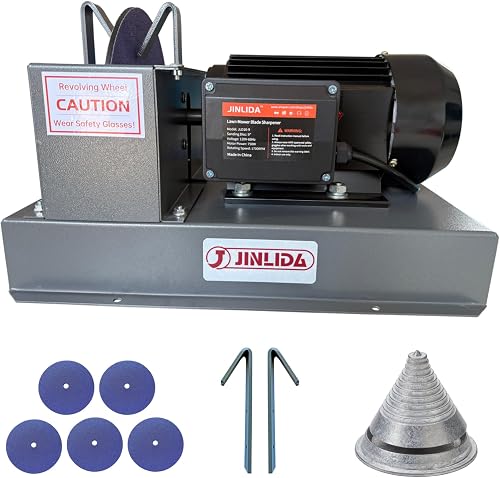
- 750W motor rated at 1 HP
- 9 in ceramic wheel
- Metal blade balancer
- Five replaceable 60-grit ceramic discs
A powered bench machine with a ceramic wheel, blade holder and balancer. It suits buyers who want a dedicated unit for standard mower blades.
Pros
- Includes a blade balancer
- Five replaceable grinding discs
- Sturdy steel base
Cons
- Heavy at 36.9 lb
- Requires bench space
The Jinlida JLD20-9 is a powered bench grinder with a 9 in ceramic wheel, 750W motor rated at 1 HP and a metal blade balancer. It also comes with five replaceable 60-grit ceramic discs.
Its steel base and blade mounting bracket provide a fixed sharpening station. The included tool holders are described for 30° and 40° angles, and the balancer helps check blade balance after sharpening.
At 36.9 lb, it needs a sturdy work surface and is not a portable touch-up tool. Choose it if you want a dedicated machine with a wheel and replacement discs, and have a place to keep it set up.
SporGain Updated Lawn Mower Blade Sharpener: Best for adjustable-speed guided grinding
- Brushless motor up to 3,000 RPM
- 30° and 45° blade guides
- 60-grit and 180-grit sanding discs
- For high-lift, low-lift, Gator and flat blades
This powered SporGain machine shares the adjustable speed and two guide angles of the other model here. Compare the included disc quantities and choose the kit that fits your sharpening routine.
Pros
- Brushless motor
- Adjustable speed
- Includes fine-grit sanding discs
Cons
- Requires bench space
- Its guides are limited to 30° and 45°
This SporGain sharpener is another powered bench option, with a brushless motor adjustable up to 3,000 RPM and 30° and 45° blade guides. It is described for high-lift, low-lift, Gator and flat blades.
The kit includes three 60-grit sanding discs and 60 180-grit discs. Compare those included quantities with the other SporGain machine in this roundup, which has a different stated coarse-disc quantity.
It needs bench space and is aimed at sharpening sessions rather than quick touch-ups. If you want a powered tool with speed control and two guide angles, it belongs on your shortlist.
How should you choose a lawn mower blade sharpener?
Choose by the amount of metal you need to remove, the tools you already own and how often you sharpen. For riding mower access, compare lawn mower lift table sizes before choosing a setup.
For riding mower blade access during maintenance, see our guide to best riding lawn mower lifts.
A hand sharpener or drill attachment suits lighter upkeep, while a jig or bench grinder gives more support for repeated work.
When is a manual mower blade sharpener enough?
A manual sharpener can suit a blade that needs a light edge touch-up and a user who prefers a compact tool. The SHARPAL 103N has several preset slots and bars, but it does not hold a mower blade in a fixture.
Manual control takes care and patience. If you want to understand safe blade removal first, read How to Remove a Lawn Mower Blade? and then How to Change Lawn Mower Blades?.
Should you choose a drill attachment or angle grinder jig?
A drill attachment is compact and uses a tool many homeowners already own, while a jig adds a holder and angle adjustment to an angle grinder setup. The UF-SHARP attaches to a drill, and the SporGain jigs adjust across 15°–45°.
Choose a jig if you want the blade held and the sharpening angle guided. Check that the blade width and grinder adapters match your equipment before you start.
When does a powered bench sharpener make sense?
A powered bench sharpener makes sense when you sharpen blades regularly and have a stable place to keep the machine. Models in this roundup include sanding-disc machines and larger grinders with ceramic wheels.
Bench machines need more room and care around a fast-moving abrasive wheel. Follow the machine and mower manuals, wear suitable eye protection, and secure the blade before sharpening.
What blade condition should guide your sharpener choice?
A dull edge and a damaged blade are different jobs. Routine edge maintenance can use a hand tool or attachment, while deep chips, bends or missing metal call for a careful inspection and may mean the blade should be replaced.
The Sharp Pebble cordless tool is specifically described for maintenance rather than substantial damage. If a blade is cracked, bent or missing material, do not try to solve the problem with a light touch-up tool.
Check the blade maker's guidance for the original edge angle. A jig with adjustment can match a wider range, while a machine with preset guides works best when one of its angles matches your blade.
How do you keep a sharpened mower blade balanced?
Check blade balance after sharpening so one side does not carry more weight than the other. Vibration during mowing can be a sign that the blade needs inspection and balancing.
The VEVOR and Jinlida machines include a blade balancer. With any other sharpening method, use an appropriate balancing tool and follow your mower manual before reinstalling the blade.
Which lawn mower blade sharpener should you choose?
Choose the SHARPAL 103N for a versatile hand tool, the Sharp Pebble for cordless maintenance on standard residential blades, or the SporGain jig if you already own an angle grinder and want adjustable guidance. For repeated work, choose a bench machine that fits your available space and the blade angles you need.
If mower maintenance also includes soil preparation, see our guide to garden tillers and cultivators. For this roundup, match the sharpener to your blade condition, preferred method and storage space before you buy.
Our top 3 picks at a glance
-
1
Best for hand sharpening
SHARPAL 103N All-in-1 Knife Garden Tool Lawn
9.7/10 our score
See it on Amazon -
2
Best for cordless touch-ups
Sharp Pebble Cordless Lawn Mower Blade Sharpener
9.6/10 our score
See it on Amazon -
3
Best for adjustable angle-grinder guidance
SporGain [Updated] Lawn Mower Blade Sharpener 15°-45°
9.4/10 our score
See it on Amazon
Frequently asked questions
What is the best lawn mower blade sharpener for most homeowners?
The SHARPAL 103N is a versatile hand sharpener for homeowners who want one tool for mower blades and other garden edges. If you prefer powered sharpening, choose a drill attachment or a guided angle grinder jig based on tools you own.
For frequent sharpening, a dedicated bench machine may be a better fit.
Are hand sharpeners or powered mower blade sharpeners better?
Hand sharpeners are compact and do not need a motor or separate power tool. Drill attachments and angle grinder jigs use tools you may already own, while bench machines offer a dedicated setup for regular work.
Choose based on blade condition, sharpening frequency and storage space.
Can a cordless sharpener sharpen a damaged mower blade?
A cordless touch-up tool is meant for routine maintenance, not substantial blade damage. The Sharp Pebble is described for standard residential blades and says chipped, deeply dented or missing metal needs a grinder first.
Inspect the blade and follow your mower maker's service guidance before sharpening.
What angle should I use to sharpen a lawn mower blade?
Use the angle that matches your blade's existing cutting edge and your mower maker's guidance. Some tools offer adjustable ranges, while others have preset slots or fixed guides.
Keeping the original edge angle helps avoid removing more metal than needed.
Do I need to remove the mower blade before sharpening?
Many sharpening methods require blade removal so you can secure the blade and control the angle. The Sharp Pebble cordless tool says removal is optional for many standard residential blades, but badly worn edges are best handled with the blade removed.
Disconnect the spark plug or power source and follow the mower manual.