
How to Adjust a Carburetor on a Lawn Mower?
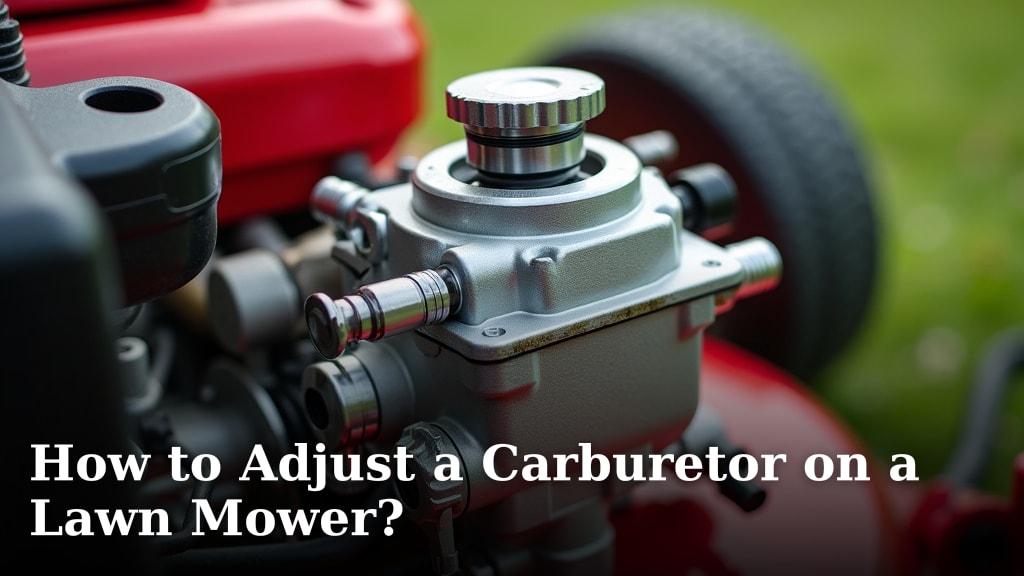
To adjust a carburetor on a lawn mower, you will primarily focus on the air-fuel mixture screw and the idle speed screw. This process helps your engine run smoothly and efficiently, preventing common issues like stalling or rough performance.
A properly tuned carburetor ensures your lawn mower gets the right amount of fuel and air for optimal combustion. If your mower is running rough, stalling, or not starting easily, a carburetor adjustment might be just what it needs.
- Locate the adjustment screws.
- Understand their function (air-fuel mixture and idle speed).
- Make small, precise adjustments.
- Test the mower’s performance.
- Fine-tune as needed.
Ready to get your lawn mower purring like new? Let’s walk through exactly how to adjust a carburetor on a lawn mower, step by step.
Tuning Your Lawn Mower Carburetor
Adjusting your lawn mower’s carburetor might sound like a big job, but it’s often simpler than you think. It’s about finding the right balance of air and fuel. This balance is key for a smooth-running engine, and it can save you frustration and even money on repairs down the road.
Before you grab your tools, let’s talk about safety. Always disconnect the spark plug wire first. This prevents the engine from accidentally starting while you’re working on it. You don’t want any surprises when your hands are near moving parts!
Gathering Your Essential Tools
Having the right tools makes any job easier. For carburetor adjustment, you won’t need a whole workshop. A few basic items should do the trick.
- Screwdrivers (flathead and Phillips, various sizes)
- Nut drivers or small wrenches (for specific screw types)
- A tachometer (optional, but very helpful for precision)
- Clean shop rags
- Safety glasses
A tachometer helps you measure the engine’s RPMs. This allows for a much more accurate adjustment. If you don’t have one, don’t worry; you can still adjust by sound and feel, but it takes a little more practice.
Locating the Carburetor Adjustment Screws
Your lawn mower’s carburetor usually sits right on the engine block. It’s a small, metallic device that mixes air and fuel. Finding the adjustment screws is the first real step in this process.
Most carburetors have two main screws you’ll be dealing with:
- High-speed/Main Jet Mixture Screw: This controls the fuel mixture at higher engine speeds.
- Idle Speed Screw: This sets how fast the engine runs when the throttle is at its lowest setting.
Some older or more complex carburetors might have a low-speed mixture screw too. But for most common lawn mowers, you’ll focus on the two main ones.
Identifying Screw Types
The screws often look like small metal pins with a slot for a screwdriver. Sometimes they are plastic. You might even find them hidden under plastic caps. These caps are often put there by manufacturers to meet emission standards, preventing easy adjustments.
If you find caps, you might need to carefully pry them off. Be gentle! We’re trying to adjust, not break, your carburetor.
Understanding Carburetor Functionality
Think of your carburetor as the engine’s chef. It takes air and fuel and mixes them in just the right proportions to create a combustible blend. If the mix is off, your engine will let you know.
Too much fuel (rich mixture) can cause black smoke, sputtering, and stalling. Too much air (lean mixture) can lead to overheating, backfiring, and a lack of power. We’re aiming for that “Goldilocks” zone—just right!
The Air-Fuel Mixture: Rich vs. Lean
Adjusting the mixture screw changes how much fuel goes into the air. Turning the screw clockwise usually leans the mixture (less fuel). Turning it counter-clockwise typically enriches the mixture (more fuel).
This is where precision comes in. Small turns make a big difference. We’re talking quarter-turns, not full rotations.
The Idle Speed: Keeping it Steady
The idle speed screw controls how far the throttle plate closes when the engine is idling. A proper idle prevents the engine from stalling when you let off the throttle.
If your mower cuts out every time you disengage the blade or let go of the handle, your idle speed might be set too low.
The Step-by-Step Adjustment Process
Okay, you’ve located the screws, gathered your tools, and understand the basics. Now comes the exciting part: making the adjustments. Remember to always work safely!
Initial Setup and Warm-Up
Before you start turning screws, get your engine ready. Reconnect the spark plug and start the mower. Let it run for about 5-10 minutes to reach its normal operating temperature. An engine that’s too cold won’t give you accurate readings.
Once it’s warm, turn off the engine and disconnect the spark plug again. Safety first, always!
Adjusting the High-Speed Mixture (Main Jet)
This is arguably the most critical adjustment for overall performance. This screw affects how your mower performs under load, like when you’re cutting thick grass.
Step-by-step:
- Gently seat the screw: With the engine off and spark plug disconnected, carefully turn the high-speed mixture screw clockwise until it just lightly seats. Do NOT overtighten, or you can damage the carburetor.
- Back out 1.5 to 2 turns: From the seated position, turn the screw counter-clockwise 1.5 to 2 full turns. This is your starting point.
- Restart and test: Reconnect the spark plug, start the engine, and let it warm up again.
- Fine-tune under load: Engage the blades or try cutting some grass. Slowly turn the screw clockwise (leaner) in 1/8 to 1/4 turn increments. Listen for the engine to speed up or smooth out.
- Find the peak RPM: Continue turning until the engine runs at its fastest and smoothest under load. Then, turn it counter-clockwise (richer) just slightly (about 1/8 to 1/4 turn) from that peak. This makes sure the engine doesn’t run too lean, which can cause overheating and damage (SAE International found that slightly rich mixtures often provide better cooling and power for small engines).
You’re looking for that sweet spot where the engine sounds powerful, doesn’t bog down, and isn’t emitting excessive smoke.
Setting the Idle Speed
Once your high-speed mixture is dialed in, it’s time to set the idle. This ensures your mower doesn’t stall when it’s just running without cutting.
- Adjust the throttle: Set your mower’s throttle to the lowest (idle) setting.
- Turn the idle screw: Slowly turn the idle speed screw clockwise to increase the idle RPM, or counter-clockwise to decrease it.
- Listen and observe: You want the engine to run smoothly without sounding like it’s about to stall. The blades should not be engaged, or if they are, they should be barely moving.
- Check for stability: A good idle should be steady, not surging up and down. If it’s surging, your idle mixture might be off, or there could be a vacuum leak.
Many mower manufacturers recommend an idle speed between 1,700 and 2,000 RPM. If you have a tachometer, aim for that range. Without one, trust your ears: smooth and steady is the goal.
Post-Adjustment Checklist
After you’ve made your adjustments, it’s a good idea to run through a quick check to make sure everything is good to go.
- Did you reconnect the spark plug wire?
- Does the engine start easily?
- Does it idle smoothly without stalling?
- Does it run strong under load (cutting grass)?
- Is there any excessive smoke (black or white)?
- Are all tools put away safely?
If you answered yes to the first five and yes to the last one, you’ve likely done a great job! If not, you might need to do some slight fine-tuning.
Common Issues After Adjustment and Troubleshooting
Sometimes, even after an adjustment, your mower might still act up. Don’t worry; this is a common part of the learning process. Let’s look at a few scenarios.
Engine Still Runs Rough or Stalls
If your mower is still struggling, double-check your adjustments. Did you turn the screws too much? Or not enough? Remember, small changes are key.
Also, consider other factors. A dirty air filter, old fuel, or a clogged fuel filter can all mimic carburetor issues. We often find that checking these simple things first can save a lot of headaches.
Surging or Hunting
If your engine speeds up and slows down rhythmically, it’s often called “surging” or “hunting.” This can happen if the mixture is too lean, especially at idle. Try enriching the idle mixture screw slightly (turn counter-clockwise).
A vacuum leak can also cause surging. Check all hoses and gaskets connected to the carburetor for cracks or looseness. The University of Nebraska-Lincoln Extension suggests that vacuum leaks are a frequent cause of poor small engine performance.
Black or White Smoke
Black smoke usually means your engine is running too rich (too much fuel). Try leaning out the high-speed mixture screw (turn clockwise). White or blue smoke often indicates burning oil, which points to a different engine problem, not typically a carburetor issue.
This table summarizes common issues and potential fixes:
| Symptom | Possible Cause | Adjustment/Fix |
|---|---|---|
| Engine stalls at idle | Idle speed too low, mixture too lean | Increase idle speed, enrich idle mixture |
| Lack of power, backfiring | Mixture too lean (under load) | Enrich high-speed mixture |
| Black smoke, sputtering | Mixture too rich (under load) | Lean out high-speed mixture |
| Engine “surges” at idle | Idle mixture too lean, vacuum leak | Enrich idle mixture, check for leaks |
| Engine won’t start | Mixture way off, spark/fuel issue | Check initial screw settings, other components |
Don’t be afraid to try again. It takes a little patience. Most of us didn’t get it perfect the first time!
Conclusion
Adjusting your lawn mower’s carburetor can feel intimidating. But by understanding the roles of the mixture and idle screws, you can restore your mower’s performance. Remember to prioritize safety and make small, precise adjustments. With a little patience, you’ll have your mower running smoothly and efficiently again.
You’ve gained the knowledge to diagnose common issues and fine-tune your engine. So grab your tools, and get ready to enjoy a perfectly manicured lawn, powered by your newly adjusted mower!
Frequently Asked Questions
How often should I adjust my lawn mower carburetor?
You generally only need to adjust your carburetor if you notice performance issues like stalling, rough idling, or a lack of power. Regular maintenance like cleaning the air filter and using fresh fuel can often prevent the need for frequent adjustments.
Can a dirty carburetor cause my lawn mower to run poorly?
Yes, absolutely. A dirty or clogged carburetor is a very common reason for poor engine performance. Before adjusting, it’s often a good idea to clean the carburetor or check for fuel system issues, as this might solve the problem without needing adjustments.
What if my lawn mower only has one adjustment screw?
Some simpler lawn mower carburetors, especially on newer models, might only have an idle speed screw, or no adjustable screws at all. If there’s only one, it usually controls the idle. If there are no screws, the carburetor is likely factory-set and not designed for user adjustment.
Is it better to run a lawn mower engine slightly rich or slightly lean?
It’s generally safer to run an engine slightly rich (more fuel) rather than too lean (less fuel). A lean mixture can cause your engine to overheat and lead to serious damage over time. A slightly rich mixture might produce a little more smoke but is less harmful.
What is the difference between a high-speed and low-speed mixture screw?
The high-speed mixture screw controls the fuel-air ratio when your engine is running at full throttle or under a heavy load. A low-speed mixture screw, found on some carburetors, specifically adjusts the fuel-air mix when the engine is idling or at low RPMs.
