9 Best Brush Cutter Blades for Trimmers (November 2026)
The best brush cutter blades for weed eater include the Forester Chainsaw Brush Cutter Blade + File for heavy brush on powerful trimmers, the CALPALMY Brush Cutter Blade and Adapter Kit for trying three tooth counts, and the CALPALMY for a two blade sharpening kit.
On this page (10 sections)
- Our top brush cutter blades for trimmers and weed eaters
- How the best brush cutter blade options compare
- How we compared brush cutter blades
- How do I choose the best brush cutter blade for my trimmer?
- Which tooth count is best for brush cutter blades?
- What size brush cutter blade should I buy?
- Does a brush cutter blade fit a weed eater?
- How do I install, sharpen and care for brush cutter blades?
- When should I use a blade instead of string?
- Verdict: which brush cutter blade should you buy?
The best brush cutter blade is the one that matches your trimmer, your arbor size and the growth on your land. For thick brush, a 9 in 20 tooth chainsaw blade is the common starting point.
For grass and weeds, a steel blade or a high tooth count blade may cut with a finer finish.
We compared nine options by tooth count, diameter, material, arbor fit and what is in the box. Our score weighs specs, features and buyer feedback against what you are shopping for.
We checked the specs for each model and looked at fit limits first, because a blade that does not fit is not useful.
Start with what is a weed trimmer if you are new to trimmers and edgers. Then check your shaft type and arbor size before you compare tooth counts.
A straight shaft trimmer with a 1 in arbor is the most common setup in this group.
Our picks at a glance
-
1
 Best for heavy brush on powerful trimmers
Forester Chainsaw Brush Cutter Blade + File
9.7/10 our score
See it on Amazon -
2
 Best for trying three tooth counts
CALPALMY Brush Cutter Blade and Adapter Kit
9.6/10 our score
See it on Amazon -
3
- 4
 Check it
Husqvarna Brushcutter Scarlett Blade 8 in 22 Tooth
Best for woody growth with a smooth cut - 5
 Check it
ChoirLingo SK5 Steel Brush Cutter Blade
Best for grass and weeds in a two pack - 6
 Best for a simple two pack chainsaw bladeCheck it
- 7
 Check it
Renegade Blade 1 Blade 10 in-80t
Best for fine cutting with carbide teeth - 8
 Check it
vidica 2 Pack Carbon Steel Brush Cutter
Best for a low tooth count two pack - 9
 Check it
IRONHIT 9 in x 20T Chainsaw Tooth Brush
Best for a three blade kit with adapters
Our top brush cutter blades for trimmers and weed eaters
The Forester ranks first for heavy brush because it pairs a 9 in 20 tooth chainsaw design with an included file. The CALPALMY kit ranks next because it gives you three tooth counts and two adapter kits.
The list then moves from specialized multi blade kits to simpler single blades and two packs.
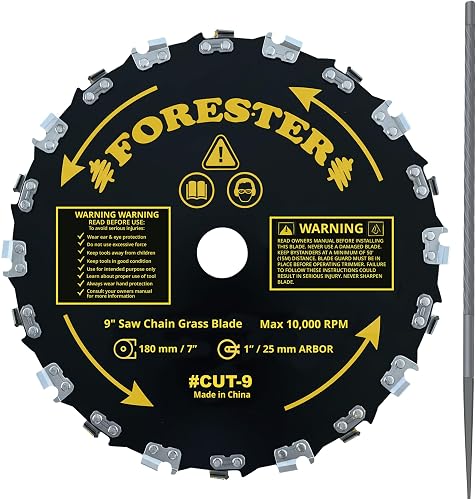
Forester Chainsaw Brush Cutter Blade + File: Best for heavy brush on powerful trimmers
- 9 in x 20 teeth chainsaw tooth blade
- 1 in arbor hole with 20 mm bushing
- Includes 13/64 in file
- Cuts material up to 2.5 in thick
- Rated to 10,000 RPM
A 9 in 20 tooth chainsaw blade with an included file for sharpening. It fits most straight shaft trimmers and suits higher horsepower models for tougher brush.
Pros
- Included file for chain sharpening
- Large 9 in cutting area
- 20 mm bushing adds fit options
Cons
- Conversion kit sold separately for trimmer head setups
- Not for curved shaft or electric trimmers
- Best on 35 cc or larger trimmers
This blade suits owners with a powerful straight shaft trimmer who clear saplings, thick brush and small trees. Its 9 in diameter covers more ground per pass than an 8 in blade.
The 20 chainsaw teeth are meant for aggressive cutting, and Forester says the blade can cut material up to 2.5 in thick.
The included 13/64 in file matters in daily use because chainsaw tooth edges need regular touch ups. A 1 in arbor hole and a 20 mm bushing give fit options for many straight shaft models.
Forester says it performs best on trimmers of 35 cc or more with larger guards.
The main trade off is setup. A conversion kit is sold separately if your trimmer still has a trimmer head.
No kit is needed if your machine is already set up as a brush cutter. It is not for curved shaft or electric trimmers, so check your model before you order.
CALPALMY Brush Cutter Blade and Adapter Kit: Best for trying three tooth counts
- Three blades: 9 in x 20T, 9 in x 36T, 10 in x 80T
- Manganese steel with carbide tipped teeth
- Two universal adapter kits included
- 1 in arbor fit
- Works with most straight shaft trimmers
Three blades with two adapter kits let you match tooth count to the job. The 20T suits woody brush, the 36T suits mixed growth, and the 80T suits lighter vegetation.
Pros
- Three blade types in one kit
- Two adapter kits with washers, nuts and wrenches
- Manganese steel with carbide tipped teeth
Cons
- Not for ECHO SRM Series
- Three blades may be more than a light job needs
- Check arbor and adapter fit before install
This kit suits buyers who want to learn which tooth count fits their land without buying three separate blades. You get a 9 in 20T blade for woody brush, a 9 in 36T blade for mixed growth and a 10 in 80T blade for lighter vegetation and thick grass.
That range is the core value here.
CALPALMY says the blades use manganese steel with carbide tipped teeth. The kit also includes two universal adapter sets with thrust washers, collar nuts and wrenches.
That hardware helps if your trimmer needs a different mount than the one already on the shaft.
Fit is still the limit. The kit is designed for straight shaft trimmers with a 1 in arbor and does not work with ECHO SRM Series models.
Against the Forester, you trade a dedicated sharpening file and a single focused blade for more choice and more parts to store.
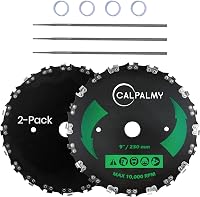
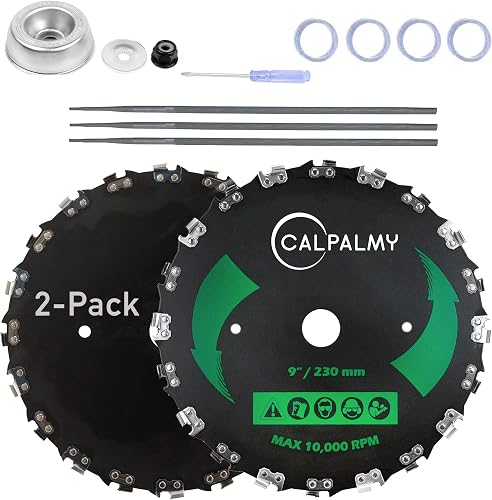
CALPALMY: Best for a two blade sharpening kit
- Two 9 in x 20T blades
- Three round files included
- Four washers included
- Carbon steel with carbide teeth
- 1 in arbor, rated to 10,000 RPM
A two pack of 9 in 20T chainsaw tooth blades with files and washers. It suits gas or electric straight shaft trimmers from Husqvarna, Stihl, Ego, Oregon and Hitachi.
Pros
- Two blades plus files and washers
- Carbon steel resists heat and rust
- Spare blade reduces downtime
Cons
- Only one tooth count
- Straight shaft trimmers only
- Files are for maintenance, not first time setup
This two set suits owners who want a spare 9 in 20T blade plus sharpening files in one box. CALPALMY includes two blades, three assorted round files and four washers.
That mix supports install and upkeep without a separate trip for basic parts.
The blades use carbon steel with carbide teeth and a 1 in arbor. They are listed for gas or electric straight shaft trimmers from Husqvarna, Stihl, Ego, Oregon and Hitachi, with a max speed of 10,000 RPM.
The 9 in size balances reach with control in tight spaces.
Compared with the three blade CALPALMY kit, this set is simpler and gives you a spare of the same tooth count. Compared with the KAKO two pack, you get files and washers here.
The trade off is you cannot switch to a 36T or 80T blade for lighter work.
Husqvarna Brushcutter Scarlett Blade 8 in 22 Tooth: Best for woody growth with a smooth cut
- 8 in 22 tooth blade
- 1 in arbor
- Designed for woody growth
- Tooth design helps reduce pinching
- For brushcutters and clearing saws
An 8 in 22 tooth Scarlett blade for brushcutters and clearing saws. Its tooth design aims for a smooth cut with less risk of pinching in wood.
Pros
- Focused design for woody growth
- Smaller 8 in size for control
- Single blade keeps choice simple
Cons
- No adapter kit in the box
- Smaller than 9 in and 10 in options
- One tooth count only
This blade suits brushcutter and clearing saw owners who want a named brand blade for woody growth. Husqvarna lists it as the Scarlett blade 8 in 22 tooth, part 596279601, with a 1 in arbor.
The smaller diameter can feel easier to control in dense growth.
Husqvarna says the tooth design gives a smooth cut and helps reduce the risk of pinching in wood. That design focus is different from a chainsaw tooth blade, which is built for aggressive bite.
For brush and woody stems, a smooth cut can mean less grabbing.
The trade off is scope. There is no adapter kit, no spare blade and no file in this package.
Against 9 in and 10 in blades, it covers less area per pass. Choose it if you already have the right mount and want a single purpose blade from Husqvarna.
ChoirLingo SK5 Steel Brush Cutter Blade: Best for grass and weeds in a two pack
- SK5 steel construction
- Two blades per set
- For grass, weeds and garden work
- Compatible with Husqvarna, Stihl, Oregon and Hitachi
- Reversible and easy to resharpen
A two pack of SK5 steel blades for grass and weeds. ChoirLingo positions it for home, farm and professional garden maintenance with easy swapping.
Pros
- Two blades for quick replacement
- SK5 steel for wear resistance
- Suits lawn and weed cutting
Cons
- Less focused on thick woody brush than chainsaw tooth blades
- Blade size and tooth details need care when comparing
- Spare blades need safe storage
This two pack suits home, farm and garden work focused on grass and weeds. ChoirLingo uses SK5 steel and says the blades are heat treated for hardness and wear resistance.
Two blades let you swap a dull blade and keep working.
The set is listed as compatible with Husqvarna, Stihl, Oregon and Hitachi models. ChoirLingo also calls the blades reversible and easy to resharpen.
That helps if you maintain edges at home and want to extend the life of each blade.
Against chainsaw tooth blades, this option is less aimed at thick saplings and woody brush. ChoirLingo positions it for lawns, weeds, horticulture and garden maintenance.
If your main job is tall grass and weeds, that focus may be a better fit than a 20T chainsaw blade.
KAKO Brush Cutter Blade: Best for a simple two pack chainsaw blade
- Two pack 9 in x 20T
- Manganese steel
- 1 in arbor, rated to 10,000 RPM
- Sharpen with 3/16 in chainsaw file
- For straight shaft trimmers only
A two pack of 9 in 20T chainsaw tooth blades in manganese steel. It fits most gas or electric straight shaft trimmers with a 1 in arbor.
Pros
- Two blades in one pack
- Manganese steel for heat and wear resistance
- Clear file size for sharpening
Cons
- File not included
- Straight shaft only
- One tooth count only
This two pack suits buyers who want the common 9 in 20T chainsaw format at a simple spec. KAKO uses manganese steel and lists heat resistance, wear resistance and corrosion resistance as the material goals.
The 1 in arbor fits most straight shaft gas or electric trimmers.
The blade is rated to 10,000 RPM and the riveted chainsaw teeth can be sharpened with a 3/16 in chainsaw file. That file size is a plain detail to check against the files you already own.
Two blades help if you hit stones or need a fast swap.
The trade off is that no file or adapter kit is included. The CALPALMY two set includes files and washers, while the Forester includes a file.
This KAKO pack is best if you already have sharpening tools and mounting hardware for your trimmer.
Renegade Blade 1 Blade 10 in-80t: Best for fine cutting with carbide teeth
- One 10 in 80 tooth hybrid blade
- Carbide tipped teeth
- 25.4 mm arbor or 20 mm with reducer washer
- Built for high RPM trimmers
- Blade hardware not included
A single 10 in 80 tooth carbide tipped hybrid blade for multi purpose cutting. It needs your trimmer's blade mounting parts, which are not included.
Pros
- 80 teeth for finer cutting
- Carbide teeth for longer edge life
- Two arbor options with reducer washer
Cons
- Blade hardware not included
- Single blade only
- 80 teeth may load up in very thick brush
This blade suits buyers who want a high tooth count for finer cutting. Renegade Blade lists a 10 in 80 tooth hybrid with carbide tipped teeth.
The larger diameter and 80 teeth aim at multi purpose cutting rather than only woody brush.
The blade fits a 25.4 mm arbor or a 20 mm arbor with the included reducer washer. Renegade says the carbide mix is made to last longer than plain steel.
It is also built for high RPM trimmers, including 10,000 RPM and above.
The key limit is hardware. Renegade does not supply the blade mounting parts, and a blade does not fit directly on the small axle used for a string spool.
You need the discs, nut and cotter pin parts for your trimmer model. Against multi blade kits, this is a single blade choice that rewards buyers who already know their mount.
vidica 2 Pack Carbon Steel Brush Cutter: Best for a low tooth count two pack
- Two pack 10 in x 3 teeth
- Carbon steel
- 20 mm or 25.4 mm arbor
- Includes blade adapter kit and washer
- Max RPM 12,500
A two pack of 10 in 3 tooth carbon steel blades with an adapter kit and washer. The large diameter and low tooth count suit tough weeds and brush.
Pros
- Two blades with adapter kit
- 10 in diameter covers more area
- Supports 20 mm and 25.4 mm arbors
Cons
- 3 teeth give a coarser cut
- Check RPM and guard fit for your trimmer
- Less finish than high tooth count blades
This two pack suits buyers who want a large 10 in blade with a low tooth count. vidica uses carbon steel with a 3 tooth design, which gives a coarser cut than 20T, 36T or 80T blades. That design can suit tough weeds and brush where a fine finish is not the goal.
The pack includes a blade adapter kit and washer, and it fits 20 mm or 25.4 mm arbors. vidica lists compatibility with Husqvarna, Stihl, Ego, Oregon, Hitachi and Makita models. The stated max RPM is 12,500, so check your trimmer speed and guard cover before use.
Against the Renegade 10 in 80T blade, this pack trades fine cutting for a lower tooth count and a spare blade. Against 9 in chainsaw blades, it trades bite for diameter.
Choose it for open areas with tough vegetation, not for careful work near fences or beds.
IRONHIT 9 in x 20T Chainsaw Tooth Brush: Best for a three blade kit with adapters
- Three blades: 9 in x 20T, 9 in x 36T, 10 in x 80T
- 1 in arbor
- Two adapter kits included
- Manganese steel and carbide options
- For straight shaft trimmers
Three blades with two adapter kits covering chainsaw tooth and carbide tip styles. It does not fit ECHO SRM Series, Ryobi or DeWalt trimmers.
Pros
- Three tooth counts for different jobs
- Two adapter kits included
- Manganese steel build
Cons
- Does not fit ECHO SRM, Ryobi or DeWalt
- Must double check arbor size
- Kit complexity may not suit a simple swap
This kit suits buyers who want three blade sizes and two adapter kits in one package. IRONHIT includes a 9 in 20T chainsaw tooth blade, a 9 in 36T blade and a 10 in 80T carbide tip blade.
That range covers woody brush, mixed growth and lighter vegetation.
The blades use a 1 in arbor and manganese steel. The two adapter kits include thrust plates, washers, rider plates, lock nuts, collar nuts and wrenches.
That hardware can help with fit, but it also means more parts to sort before install.
Fit limits are clear here. IRONHIT says the blades do not fit ECHO SRM Series, Ryobi or DeWalt trimmers.
You should double check the arbor size of your machine before you buy. Against the CALPALMY kit, this option is similar in scope, so choose by the exclusions and the adapter parts you need.
How the best brush cutter blade options compare
The comparison comes down to tooth count, diameter, material and included hardware. Chainsaw tooth blades have 20 teeth and bite into woody growth.
Circular saw style blades have 36T or 80T and cut with a finer edge. Low tooth count blades, like the 3 tooth vidica pack, cut tough growth with fewer teeth.
Material also matters. Manganese steel, carbon steel, SK5 steel and carbide tipped teeth each aim at durability and edge life.
Carbide tips often hold an edge longer, but tooth count and sharpening still drive daily performance. A blade you can sharpen easily may serve you better than a harder blade you cannot maintain.
Fit matters most. Most blades here use a 1 in arbor for straight shaft trimmers.
Some support 20 mm or 25.4 mm arbors. Curved shaft trimmers are often not a fit.
Always check the manual for the approved blade, guard and adapter parts.
| Product | Best for | Size | Teeth | Arbor | Our score |
|---|---|---|---|---|---|
| Forester Chainsaw Brush Cutter Blade + File | heavy brush on powerful trimmers | 9 in | 20 | 1 in | 9.7 |
| CALPALMY Brush Cutter Blade and Adapter Kit | trying three tooth counts | 20T, 36T and 80T | 1 in | 9.6 | |
| CALPALMY | a two blade sharpening kit | 9 in | 20 | 1 in | 9.4 |
| Husqvarna Brushcutter Scarlett Blade 8 in 22 Tooth | woody growth with a smooth cut | 8 in | 22 | 1 in | 9.2 |
| ChoirLingo SK5 Steel Brush Cutter Blade | grass and weeds in a two pack | 9.0 | |||
| KAKO Brush Cutter Blade | a simple two pack chainsaw blade | 9 in | 20 | 1 in | 8.8 |
| Renegade Blade 1 Blade 10 in-80t | fine cutting with carbide teeth | 10 in | 80 | 25.4 mm or 20 mm | 8.5 |
| vidica 2 Pack Carbon Steel Brush Cutter | a low tooth count two pack | 10 in | 3 | 20 mm or 25.4 mm | 8.3 |
| IRONHIT 9 in x 20T Chainsaw Tooth Brush | a three blade kit with adapters | 20T, 36T and 80T | 1 in | 8.0 |
How we compared brush cutter blades
We compared the nine blades by specs that change how the blade cuts and fits. We looked at diameter, tooth count, arbor size, material, RPM limit and included parts.
We also noted exclusions, such as ECHO SRM Series, Ryobi and DeWalt limits on some kits.
We grouped the blades by job. Chainsaw tooth blades suit thick brush and saplings.
Mid tooth count blades suit mixed brush and weeds. High tooth count blades suit lighter vegetation and a finer cut.
Low tooth count blades suit tough weeds where finish matters less.
Score order follows how well each option fits the search for a brush cutter blade for trimmers. Multi blade kits score well for choice.
Single blades score well for a clear purpose. Two packs score well for spare blades and lower downtime.
How do I choose the best brush cutter blade for my trimmer?
The right brush cutter blade starts with fit, not tooth count. Check if your trimmer has a straight shaft and a 1 in arbor.
Then check if the maker approves blade use and if the guard can cover the blade size you want. Our string trimmer vs brush cutter guide helps you decide if a blade head is right for your work.
Straight shaft vs curved shaft
Straight shaft trimmers are the common fit for these blades. Curved shaft trimmers often lack the mount, torque or guard setup for a blade.
If your shaft is curved, do not force a blade swap.
Arbor size and adapter kits
Measure the arbor before you order. Most models here use 1 in or 25.4 mm.
Some use 20 mm or include a reducer washer. A blade kit may include washers, nuts and discs, while a single blade may need hardware you already own.
Guard and safety cover
A larger blade needs a guard that covers it. ChoirLingo, for example, stresses installing the safety cover and wearing eye and body protection.
Do not run a blade that sticks past the guard.
Which tooth count is best for brush cutter blades?
Tooth count controls cut style and height of growth. Fewer teeth bite harder and suit woody brush.
More teeth cut finer and suit grass, weeds and lighter brush. There is no single best count for every yard.
20 tooth chainsaw blades
A 20T chainsaw tooth blade is the standard for thick brush, saplings and woody weeds. The Forester, CALPALMY, KAKO and IRONHIT options use this format.
It cuts aggressively but may need more sharpening.
36 tooth and 80 tooth blades
A 36T blade suits mixed brush and weeds with a finer cut than 20T. An 80T blade suits lighter vegetation, thick grass and multi purpose cutting.
The Renegade 80T and the 80T blades in the CALPALMY and IRONHIT kits fit this use.
3 tooth and 22 tooth blades
A 3 tooth blade gives a coarse cut for tough weeds and brush. The Husqvarna 22 tooth Scarlett blade focuses on woody growth with a smooth cut.
These are niche choices, so match them to the growth you cut most.
What size brush cutter blade should I buy?
Blade size affects reach, control and guard fit. A 9 in blade is the most common size in this group.
A 10 in blade covers more area but needs more guard clearance. An 8 in blade gives more control in tight spots.
9 in blades for most trimmers
A 9 in blade balances reach and control for brush, weeds and saplings. Most 20T and 36T options here use 9 in.
Check your guard and trimmer power before you move up in size.
10 in blades for open areas
A 10 in blade suits open areas where fewer passes matter. The 80T and 3 tooth options use 10 in.
Make sure the guard covers the full diameter and that your trimmer can handle the load.
8 in blades for control
An 8 in blade can be easier to guide in dense growth. The Husqvarna Scarlett blade uses 8 in with 22 teeth.
It covers less area, but control may matter more in tight brush.
Does a brush cutter blade fit a weed eater?
Yes, many weed eaters can use a brush cutter blade if they are straight shaft models with the right arbor and approved blade mount. Some brands list specific models that support a blade.
Our best weed eater for brush cutting guide helps you match the machine to the job.
Stihl and other brand fit checks
Brand fit lists can help, but they do not replace your manual. Our guide on which Stihl weed eaters can use a blade covers one major brand.
For other brands, check the model number and arbor size.
Attachment vs blade swap
Some trimmers use a brush cutter attachment with its own head. Others need a conversion kit to swap a string head for a blade.
Our best brush cutter attachment for string trimmer guide covers attachment options if you do not want to change the head.
Curved shaft and electric models
Some blades list gas or electric straight shaft trimmers as a fit. That does not mean all electric models qualify.
Check shaft type, arbor size, RPM and guard fit for your exact model.
How do I install, sharpen and care for brush cutter blades?
Safe install starts with the right parts in the right order. A blade mounts with discs, washers, a nut and a cotter pin on many trimmers.
Renegade stresses that a blade does not fit directly on the string spool axle. Follow your trimmer manual for the exact stack.
Sharpening depends on tooth style. Chainsaw tooth blades often use a round file, such as 13/64 in or 3/16 in.
The Forester includes a 13/64 in file, while KAKO lists a 3/16 in file. Match the file to the tooth pitch and keep strokes even.
Care is simple but steady. Clean sap and soil after use.
Check teeth, washers and nuts for wear. Store spare blades where edges cannot hit people or get dull in a toolbox.
Our best string trimmer for tall weeds guide can help if tall weeds are your main problem and a blade may be too much.
When should I use a blade instead of string?
Use a blade when growth is thick, woody or tall enough to wrap around a string head. Use string for grass, edging and light weeds near hard edges.
Our best cordless weed eater guide can help if you want a battery model for lighter cutting.
A blade also changes safety needs. Wear eye protection, gloves, long sleeves, long pants and boots.
Keep people and animals clear of the cutting area. Work at a steady pace and let the blade do the cutting.
If your land has both lawn grass and brush patches, you may want both heads. A string head handles finishing work.
A blade head handles clearing work. That split is often more useful than forcing one head to do both jobs.
Verdict: which brush cutter blade should you buy?
Pick the Forester if you clear thick brush and saplings on a powerful straight shaft trimmer. Pick the CALPALMY 3 blade kit if you want to try 20T, 36T and 80T teeth with adapter kits.
Pick the Husqvarna Scarlett blade if you want a single 8 in blade for woody growth.
Pick the ChoirLingo two pack if your main work is grass and weeds. Pick the Renegade 80T if you want carbide teeth and a finer cut, and you already have blade hardware.
Pick the vidica two pack if you want a 10 in low tooth count blade with an adapter kit.
Before you order, check shaft type, arbor size, guard cover and RPM limit. That best brush cutter blade choice will fit your trimmer and cut the growth you actually have.
Then match tooth count to the job, and keep a spare blade or sharpening file ready for long clearing days.
Our top 3 picks at a glance
-
1
Best for heavy brush on powerful trimmers
Forester Chainsaw Brush Cutter Blade + File
9.7/10 our score
See it on Amazon -
2
Best for trying three tooth counts
CALPALMY Brush Cutter Blade and Adapter Kit
9.6/10 our score
See it on Amazon -
3
Frequently asked questions
What is a weed trimmer blade called?
A weed trimmer blade for brush is usually called a brush cutter blade. It replaces the string head on a straight shaft trimmer for cutting brush, weeds and saplings.
Check arbor size and shaft type before you buy.
Can a weed eater use a brush cutter blade?
Yes, many straight shaft weed eaters can use a brush cutter blade with the right adapter. Curved shaft models often cannot.
Confirm the arbor size, guard cover and trimmer manual before installing a blade.
Are brush cutter blades better than string?
Brush cutter blades are better for thick brush, saplings and woody weeds. String is better for grass, edging and light weeds near fences.
Choose by the growth you cut most, and keep both heads if your trimmer allows it.