9 Best Chainsaw Chain Sharpeners (November 2026)
The best chainsaw chain sharpeners include the Stihl 2 in 1 Easy File Chainsaw for simple 3/8 in maintenance, the Sharp Pebble Electric Chainsaw Sharpener Kit for precise electric sharpening, and the Hipa 12 Pack Chainsaw File for a complete manual file kit.
On this page (4 sections)
The best chainsaw chain sharpener for most users is the Stihl 2 in 1 Easy File Chainsaw, because it handles the cutter and the depth gauge in a single guided pass. That gives home users a clear process without juggling separate files.
We compared guided files, compact portable tools and electric grinders for common chain sizes. The right choice depends on whether you maintain one chain now and then, keep several saws ready, or prefer a fixed station at home.
A guided manual file suits occasional yard work because it is quiet, simple to store and ready wherever you keep the saw. An electric grinder makes sense when you sharpen often, maintain more than one chain, or want a repeatable angle across many cutters.
Portable tools help when you need a touch up away from a bench. They still need the right file, wheel or bit for your pitch and cutter size.
A dull chain can pull, chatter and make cutting feel harder, while a sharp chain usually feeds through wood with less pressure from you. Matching the tool to the chain therefore comes before choosing a brand.
Check the pitch, cutter profile and any markings on the chain or bar before you buy. If you are still choosing the saw itself, start with our chainsaw buying guide.
No sharpener can fix a worn or unsafe chain. When the chain shows damage, replacement is the safer path.
Our picks at a glance
-
1
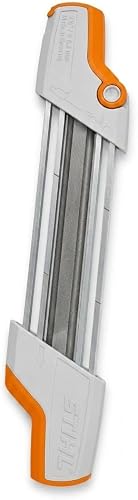 Best for simple 3/8 in maintenance
Stihl 2 in 1 Easy File Chainsaw
9.7/10 our score
See it on Amazon -
2
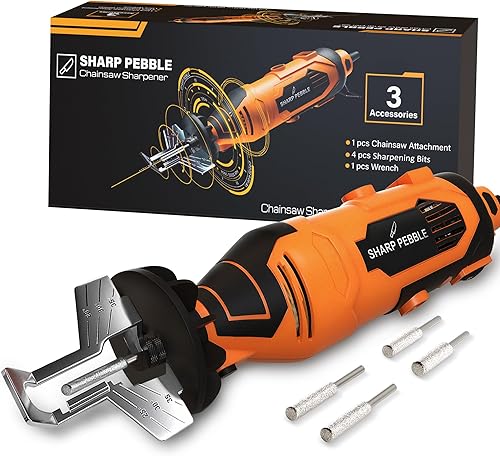 Best for precise electric sharpening
Sharp Pebble Electric Chainsaw Sharpener Kit
9.6/10 our score
See it on Amazon -
3

- 4
 Best for compact portable sharpeningCheck it
- 5
 Check it
VEVOR Electric Chainsaw Sharpener
Best for frequent bench sharpening - 6
 Check it
NEO-TEC Electric Chainsaw Sharpener Kit On-Saw Quick
Best for on-saw touch-ups - 7
 Check it
VEVOR Electric Chainsaw Sharpener
Best for a lighter bench setup - 8
 Check it
FREEZE2TRIM Tactical Chainsaw Sharpener
Best for guided manual bar sharpening - 9
 Check it
KonKell 230W Electric Chainsaw Sharpener
Best for multi-angle shop sharpening
The best chainsaw chain sharpeners for different jobs
The best chainsaw chain sharpener depends on your work pattern. The Stihl is the simplest guided file, Sharp Pebble offers electric angle control, and Hipa covers the widest range of manual file sizes.
Other options in this group take different approaches to the same job. Some stay on the saw, some sit on a bench, and some are made to travel in a small kit.
Our score weighs specs, features and buyer feedback against the needs of someone shopping for a chainsaw sharpener. The products appear from highest score to lowest score.
That order is a guide, not a rule for every yard. A lower scored tool can still be the better fit if its size, power needs or chain coverage match your setup.
Read each write-up for the details that matter in daily use. Look at chain pitch, included files or wheels, weight, storage and whether power is required.
Then match those details to the saws you own and the places you work. The best choice is the one you can set up safely and use consistently.
Stihl 2 in 1 Easy File Chainsaw: Best for simple 3/8 in maintenance
- 2 in 1 file holder
- Sharpens cutters and lowers depth gauges together
- 3/8 in Easy File
- 5605 750 4305
This guided file holder handles cutter sharpening and depth-gauge lowering in one operation. It suits occasional users with compatible 3/8 in saw chains.
Pros
- Combines 2 filing steps
- Compact manual design
- Includes round and flat files
Cons
- Focused on 3/8 in chains
- Requires manual filing strokes
The Stihl 2 in 1 Easy File Chainsaw is the strongest choice for occasional maintenance on a compatible 3/8 in chain. Its 2 in 1 file holder sharpens the cutter and lowers the depth gauge in one operation, so you do not need to handle those steps separately.
The system includes 2 round files, 1 flat file and a filing guide. That combination gives you the round files for cutter work and the flat file for the depth-gauge step.
Stihl identifies this model as 5605 750 4305 and describes it for 3/8 in Easy File use. The integrated file tolerance compensation is useful when you want a guided process rather than a freehand chainsaw sharpener blade.
The trade-off is range. This is a focused tool for the stated chain size, not a multi-size electric grinder.
Check your chain pitch before choosing it. If your chain matches, the guided design can make routine touch-ups feel more consistent.
Keep the files clean and dry after use and store the holder where the edges will not knock against other tools. Clean files and steady, even strokes help protect the cutter profile.
This design suits a user who sharpens one compatible chain at intervals and values simplicity over speed. It is less suited to someone maintaining many pitches or wanting powered grinding.
For occasional work, that focus can be an advantage rather than a limit. You get a clear tool for a clear job without extra wheels, cords or setup steps.
Sharp Pebble Electric Chainsaw Sharpener Kit: Best for precise electric sharpening
- 120V electric tool
- Adjustable speed settings
- Angle guide attachment
- 4 file-size grinding wheel bits
The electric tool uses an angle guide and several wheel sizes to sharpen each tooth at a consistent setting. It fits users who want repeatable sharpening without relying only on freehand filing.
Pros
- Includes 4 grinding wheel bits
- Angle guide attachment
- Adjustable speed settings
Cons
- Needs a 120V power source
- Requires setup before sharpening
The Sharp Pebble Electric Chainsaw Sharpener Kit is the best fit when you want repeatable electric sharpening with several wheel sizes. Its angle guide attachment helps set the grinding position, while adjustable speed settings let you work through the chain at a controlled pace.
The 120V tool includes a wrench and 4 file-size grinding wheel bits: 5/32, 3/16 and 7/32 in sizes, with 7/32 in represented twice in the supplied set. The 7.99 x 2.79 x 1.1 in body weighs 16 oz.
A powered tool can help keep each cutter closer to the same angle than unstructured freehand filing. You still need to choose the correct wheel, secure the chain and use light, even contact.
Read How to Use an Electric Chainsaw Sharpener before setting up any powered model. Sharp Pebble suits users who want speed and angle guidance, but it needs a 120V outlet and more setup than a file.
Hipa 12 Pack Chainsaw File: Best for a complete manual file kit
- 12-piece kit
- 6 round files
- 6 in flat file
- Depth gauge and quick check gauges
- Bar groove cleaner
This kit covers many common chain sizes and adds tools for depth gauges, pitch checks and bar-groove cleaning. It suits users maintaining several chainsaws or pole saws.
Pros
- Six round file sizes
- Includes flat file and gauges
- Portable orange pouch
Cons
- Manual filing takes practice
- More pieces to organize
The Hipa 12 Pack Chainsaw File is the best manual kit for households with several chain sizes. Its 6 round files cover 5/32, 3/16, 7/32, 1/8, 11/64 and 13/64 in, while the 6 in flat file handles depth-gauge work.
The 12-piece kit also includes a .025 in and .030 in depth-gauge tool, a quick check gauge and a bar groove cleaner. The orange pouch makes the set easier to carry to a work area or keep with other saw tools.
Hipa states compatibility across 1/4, .325, 3/8, 3/8 LP, .404, 7/16, .354 and 1/2 in chain pitches. That wide range is the main reason to choose it over a single-size chainsaw sharpener blade.
Manual filing gives you control without a motor, but it rewards careful angle and pressure. Compare it with our guide to the best chainsaw chain files if you prefer a file-first setup.
F WPKID Chainsaw Sharpener: Best for compact portable sharpening
- Portable sharpener
- 5 diamond drill bits and blades
- 4 to 22 in electric and gas chainsaws
- 12.3 oz
The compact F WPKID tool is aimed at portable chain maintenance and includes 5 diamond drill bits and blades. Its stated saw range covers 4 to 22 in electric and gas-powered chainsaws.
Pros
- Small and light
- Includes 5 grinding pieces
- Works with electric and gas chainsaws
Cons
- Exact chain pitch fit needs checking
- Less detailed guidance than a file kit
The F WPKID Chainsaw Sharpener is the best compact option for portable maintenance across 4 to 22 in electric and gas-powered chainsaws. It weighs 12.3 oz and measures 4 x 3 x 2.5 in, so it takes little room in a saw kit.
The tool includes 5 diamond drill bits and blades for grinding work. That makes it more flexible than a single-bit manual tool, although you should still confirm the bit and chain fit before sharpening.
Its portable format suits gardening and woodworking tasks where carrying a larger bench grinder would be inconvenient. The trade-off is that the product information gives a saw-size range but not a full list of chain pitches.
Choose it when size and transport matter most. For exact file-size coverage, the Hipa kit gives clearer round-file measurements.
At this size, it can sit with other saw accessories without taking over a shelf or toolbox. That makes it easier to keep with the saw instead of leaving it in a distant workshop.
Portable does not mean carefree. You still need a stable way to hold the saw, good light and the correct bit for the cutter you are touching up.
Keep the bits organized so you can find the right one without mixing them up. Store them dry and separate from loose hardware that could dull or chip the diamond coating.
This option suits someone who values a light, travel-friendly setup for light maintenance. It suits less well when you need detailed pitch matching or a full set of labeled file sizes.
VEVOR Electric Chainsaw Sharpener: Best for frequent bench sharpening
- 230W motor
- Up to 3000 RPM
- 5.5 in grinding wheel
- Adjustable grinding angles
This 230W bench sharpener is suited to repeated work across several common chain pitches. Its adjustable angles and 5.5 in wheel favor a fixed sharpening station over field use.
Pros
- 230W motor
- Supports 4 common pitches
- Adjustable grinding angles
Cons
- Heavy at 17.35 lb
- Needs bench space
The VEVOR Electric Chainsaw Sharpener is the best choice for a fixed station that handles several common pitches. Its 230W motor reaches up to 3000 RPM, and the 5.5 in grinding wheel supports repeated sharpening work.
The sharpener covers 1/4, .325, 3/8 and .404 in pitches. Adjustable grinding angles help you position different chain profiles, so it is better suited to a multi-saw workspace than a single-size guided file.
This model measures 10 x 10 x 15 in and weighs 17.35 lb. That weight can help keep a bench tool steady, but it also makes the sharpener a poor fit for carrying between properties.
Choose it for home maintenance, logging, gardening, landscaping or repair work where a permanent setup makes sense. Check your bench space and mounting plan first.
A fixed station works best when the bench is level, well lit and clear of clutter. Give yourself room to handle the chain without crowding the wheel or reaching across the tool.
The larger wheel and higher power favor repeated work over occasional touch-ups. That can be useful when several chains need attention in one session.
It is not the tool to toss in a truck for field use. Its weight and footprint are better planned around a dedicated place in a garage or workshop.
After use, let the wheel cool, clear away debris and keep the sharpener dry. A stable setup and light, controlled contact will help you get even results across the cutters.
NEO-TEC Electric Chainsaw Sharpener Kit On-Saw Quick: Best for on-saw touch-ups
- 180W electric sharpener
- 5 adjustable speeds from 10,000 to 37,000 RPM
- 25, 30, and 35 degree angle guide
- 6 titanium-plated diamond wheels
The NEO-TEC is designed for direct on-saw sharpening and offers 5 speeds plus 3 guided angles. It suits forestry professionals and DIY users who want to avoid removing the chain for routine sharpening.
Pros
- On-saw sharpening design
- 5 speed settings
- Includes 6 diamond wheels
Cons
- Electric tool needs careful handling
- High speed requires light pressure
The NEO-TEC Electric Chainsaw Sharpener Kit On-Saw Quick is the best fit when you want to sharpen without removing the chain. Its on-saw design uses a 180W electric tool with 5 adjustable speeds from 10,000 to 37,000 RPM.
The angle guide supports 25, 30 and 35 degree settings. The kit includes a sharpener, angle guide, wrench and 6 titanium-plated diamond wheels in 5/32, 3/16 and 7/32 in sizes.
That combination suits forestry professionals and DIY yard work where stopping to remove the chain adds time. High speed sharpening still requires light contact and the right bit size for the cutter.
The 13 x 7 x 3 in tool is larger than a simple file holder, and electric use calls for a stable, careful setup. If cordless operation matters more than on-saw speed, compare the best cordless chainsaw sharpeners.
On-saw sharpening saves removal steps, but you must secure the saw carefully before touching any cutter. Let the bit do the work and keep each contact brief and even.
VEVOR Electric Chainsaw Sharpener: Best for a lighter bench setup
- 85W motor
- 5000 RPM no-load speed
- 2 grinding wheels
- LED work light
- Chain fixing clamp
This 85W bench model weighs less than the larger VEVOR and includes 2 wheel thicknesses for small and medium chains. The clamp, LED light and mounting holes support a stable sharpening station.
Pros
- Lighter bench design
- Includes 2 grinding wheels
- Built-in LED work light
Cons
- Lower power than 230W models
- Wheel choice is more limited
The VEVOR Electric Chainsaw Sharpener is the best lighter bench option in this group. Its 5.29 lb body is easier to move than the 17.35 lb VEVOR model, while the 85W motor reaches 5000 RPM no-load speed.
It includes 2 grinding wheels: a 3.2 mm wheel for smaller chains and a 4.7 mm wheel for medium chains. The chain fixing clamp, auxiliary handle, mounting holes and aluminum alloy base support a stable work position.
An LED work light can help you see the contact area, while the transparent protective shield helps block sparks and debris. The lower 85W rating means it is aimed at lighter bench work than the larger 230W grinders.
Choose this model when you want a movable bench sharpener with 2 wheel options. The product measures 9.06 x 7.48 x 13.19 in, so it still needs a clear work area.
Lighter weight makes this easier to move between a bench and storage. That flexibility can help if you do not have a permanent workshop corner.
The clamp and mounting options matter because stability affects accuracy. A chain that shifts during a pass will not sharpen evenly, no matter how good the wheel is.
The LED light and shield are practical details for a bench tool. They help you see the contact point while keeping sparks and debris away from your face.
This model suits home users who want a bench setup without the bulk of a heavier grinder. It is a better match for small and medium chains than for heavy duty work across many pitches.
FREEZE2TRIM Tactical Chainsaw Sharpener: Best for guided manual bar sharpening
- Manual bar-mount design
- Hand crank
- 3 clamping knobs
- 2 angled guide sleeves
- 3 same-size 3.2 mm bits
The FREEZE2TRIM keeps the chain installed while a bar-mounted body guides one cutter at a time. It suits users who want manual control without a battery, cord or powered grinder.
Pros
- No outlet or battery
- Chain stays installed
- Compact 5.9 oz body
Cons
- Uses one bit size
- Manual process is slower than powered grinding
The FREEZE2TRIM Tactical Chainsaw Sharpener is the best manual bar-mount option for controlled touch-ups without power. The chain stays installed while the sharpener body mounts over the guide bar and guides one cutter at a time.
The tool uses 2 angled guide sleeves and 3 clamping knobs to stabilize the body. The kit includes the sharpener body, hand crank, wrench, fastening hardware and 3 same-size 3.2 mm, or 1/8 in, sharpening bits.
At 5.9 oz and 2.68 x 2.36 x 1.06 in, it is easy to store with other chainsaw tools. The hand-crank design needs no battery, cord or outlet, which suits property maintenance away from a workbench.
The main limitation is range. All 3 bits share the same nominal size, so confirm compatibility before use and do not use the tool on cracked, bent, broken or otherwise unsafe chain parts.
Bar mounting keeps the chain in place while you work tooth by tooth. This option suits property work where power is not handy and the chain is already compatible.
KonKell 230W Electric Chainsaw Sharpener: Best for multi-angle shop sharpening
- 230W motor
- 3000 RPM maximum speed
- Multi-angle turntable
- 2 grinding wheels
The KonKell combines a 230W motor with a rotating turntable and 2 grinding wheels. It suits home or professional users who want broad pitch coverage in a heavier fixed sharpener.
Pros
- Supports 4 chain pitches
- 230W motor
- Multi-angle turntable
Cons
- Heavy at 16.32 lb
- Needs a dedicated work area
The KonKell 230W Electric Chainsaw Sharpener is the best fit for a heavier shop setup with multi-angle adjustment. Its 230W motor reaches 3000 RPM, and the rotating turntable helps position chains at different grinding angles.
It sharpens 1/4, .325, 3/8 and .404 in chains. The 2 included grinding wheels are 1/8 and 3/16 in, each with a 5.5 in diameter.
The 16.32 lb unit is better suited to a dedicated work area than a portable kit. Its 12 x 12 x 12 in size also calls for enough bench depth and room to handle the saw chain safely.
Choose KonKell when broad pitch coverage and a 230W motor matter more than low weight. The VEVOR 230W model is the closer comparison if you want a 5.5 in wheel and a different bench layout.
A turntable can make angle changes simpler when you move between chains. That helps in a shop where more than one saw needs regular attention.
The 2 wheel sizes give you a choice for different cutter profiles. You still need to match the wheel to the chain before you start grinding.
Weight and footprint are the main trade-offs. This is a tool you plan a place for, not one you carry from job to job.
With a clear bench, good light and a stable setup, it can support repeated sharpening sessions. Keep the wheels clean, store the unit dry and use light contact for even results.
Which chainsaw sharpening system fits your chain?
A manual file system is usually the simplest choice for occasional sharpening, while an electric grinder makes more sense when you maintain several chains. Start by identifying the chain pitch and cutter size before choosing a chainsaw blade sharpener.
When should you choose a manual chainsaw sharpener?
Choose a manual chainsaw sharpener when you work away from an outlet or want a compact tool. The Stihl combines cutter and depth-gauge filing for compatible 3/8 in chains, while Hipa offers more file sizes for several pitches.
The FREEZE2TRIM is different because it mounts over the guide bar and keeps the chain installed. Its hand crank gives guided control, but it uses 3 same-size 1/8 in bits.
When is an electric chainsaw sharpener worth it?
An electric chainsaw sharpener is worth considering when you sharpen multiple chains or want a repeatable grinding angle. Sharp Pebble is a compact 120V option, while the VEVOR and KonKell bench models support several common pitches.
On-saw electric sharpening can reduce chain removal steps. The NEO-TEC provides an angle guide and 6 diamond wheels, but it still requires careful bit selection and light contact.
How do you match a chainsaw sharpener blade to the chain?
Match the chainsaw sharpener blade, grinding wheel or round file to the chain's pitch and cutter profile. A file that is too large or too small can change the cutter shape and depth-gauge relationship.
That relationship affects how the chain bites into wood. A cutter and depth gauge that no longer work together can make cutting feel rough or unsafe.
The Hipa kit makes size matching easier by labeling 6 round files. Electric options here use several wheel sizes, but the correct choice still depends on the chain you are sharpening.
Start by finding the pitch and cutter size for the chain you own. Chain markings, the saw manual or a chart from the chain maker can point you to the right size.
Manual files suit users who want control and portability. They work without power and can travel in a saw kit, but they ask for practice to keep angles and pressure consistent.
Electric grinders suit users who sharpen several chains or want a repeatable setup. They still need correct wheel selection, a stable work area and light contact on each cutter.
On-saw tools reduce removal steps and can help with quick touch-ups. They also require the saw to be secured carefully and the engine stopped before you begin.
Bench tools give you a fixed place to work with better support for the chain. They need space, power and a plan for moving the chain safely to and from the bench.
Bar-mounted manual tools keep the chain installed and guide one cutter at a time. Their range can be narrow, so check the bit size against your chain before you buy.
Before sharpening, secure the saw, engage the chain brake when appropriate, wear eye protection and follow the sharpener's instructions. Replace a chain rather than sharpening it when components are cracked, bent or unsafe.
Take your time with setup because the first pass sets the pattern for the rest. Keep a simple record of which file or wheel fits each chain.
What should you do after sharpening a chainsaw chain?
After sharpening, inspect the cutters for a consistent shape and check that the depth gauges were handled correctly. A sharp chain also needs proper lubrication and tension before cutting.
Look along the chain in good light and compare one side with the other. Uneven wear or a damaged tooth can tell you that more work or a replacement is needed.
Check the chain tension with the saw stopped and the engine off. Follow the saw maker's guidance rather than guessing by feel alone.
Make sure the chain is clean and the bar groove is clear before you run the saw. Debris in the groove can affect chain movement and cutting.
Lubrication matters because a sharp chain still needs oil to move smoothly. Use the oil type and filling routine recommended for your saw.
If the chain is damaged or cannot be adjusted safely, use our guide on How to Replace a Chainsaw Chain? instead of trying to restore it. Correct replacement is safer than continuing with an unsafe chain.
Store the saw with the chain clean, dry and properly tensioned for storage. That habit helps the next sharpening session start from a known condition.
Keep the sharpener clean and store files or wheels where they will not be damaged. A well kept tool will be easier to use next time and will give more even results.
Final pick: which chainsaw chain sharpener should you choose?
The Stihl 2 in 1 Easy File Chainsaw is the best chainsaw chain sharpener for occasional users with a compatible 3/8 in chain. Pick Sharp Pebble for electric angle guidance, Hipa for many manual file sizes, and VEVOR or KonKell for a fixed bench station.
Choose NEO-TEC when on-saw electric sharpening matters, FREEZE2TRIM when you want a manual bar-mounted tool, and F WPKID when portability is the priority. Match the tool to your chain pitch, power access and sharpening frequency before you buy.
For one compatible chain and occasional work, the Stihl keeps the process simple. It combines the cutter and depth-gauge steps without needing a motor or a bench.
For several chain sizes and no power, the Hipa kit gives you labeled files and useful gauges. It asks for more practice, but it covers more ground in one pouch.
For repeat sharpening with angle control, an electric model can save effort over time. Sharp Pebble is the compact powered option, while the bench models offer broader pitch support.
For field touch-ups, a portable or bar-mounted tool may fit your routine better. Check bit size and chain fit carefully before you rely on it.
Before you buy, write down your chain pitch, cutter size and how often you sharpen. Also think about where you will sharpen, because a bench tool needs space and power while a manual kit can live with the saw.
Choose the system that matches your chain and your work pattern. That match matters more than chasing the highest score on the page.
Our top 3 picks at a glance
-
1
Best for simple 3/8 in maintenance
Stihl 2 in 1 Easy File Chainsaw
9.7/10 our score
See it on Amazon -
2
Best for precise electric sharpening
Sharp Pebble Electric Chainsaw Sharpener Kit
9.6/10 our score
See it on Amazon -
3
Frequently asked questions
What is the best chainsaw chain sharpener for most users?
The Stihl 2 in 1 Easy File Chainsaw is the best chainsaw chain sharpener for most occasional users with a compatible 3/8 in chain. It sharpens cutters and lowers depth gauges in one operation.
Choose an electric tool instead when you sharpen several chains and want adjustable grinding angles.
Are electric chainsaw sharpeners better than files?
Electric chainsaw sharpeners can make repeated angle setting easier, especially when you maintain several chains. Manual files are quieter, portable and do not need power.
The right choice depends on your chain sizes, sharpening frequency and whether you have room for a bench tool.
What size chainsaw sharpener blade or file do I need?
Match the chainsaw sharpener blade, wheel or round file to the chain's pitch and cutter size. The Hipa kit includes 5/32, 3/16, 7/32, 1/8, 11/64 and 13/64 in round files.
Check your chain markings or manual before choosing a size.
Can you sharpen a chainsaw chain while it is on the saw?
Yes, some guided tools are designed for on-saw sharpening. The NEO-TEC uses an on-saw electric design, while the FREEZE2TRIM mounts over the guide bar for manual sharpening.
Secure the saw, stop the engine and follow the tool's setup instructions before touching the chain.
How often should a chainsaw chain be sharpened?
Sharpen the chain whenever it produces fine dust instead of larger chips, needs extra pressure or cuts unevenly. The work material and contact with soil affect the interval.
After sharpening, use our guide on How Often Should You Oil a Chainsaw Chain? to keep chain care consistent.


