9 Best Mower Blade Sharpeners for Bench Grinders (November 2026)
The best mower blade sharpeners for bench grinders include the RBG Mower Blade Sharpener for preset angle grinding, the Sharp Pebble Cordless Lawn Mower Blade Sharpener for cordless touch-ups, and the SporGain [Updated] Lawn Mower Blade Sharpener 15°-45° for adjustable jig use.
On this page (14 sections)
- The best mower blade sharpeners for bench grinders
- Side by side: bench grinders, jigs and cordless sharpeners
- How we compared these mower blade sharpeners
- What angle guide should you use for bench grinder sharpening?
- Which angle guide fits your blades?
- How much motor power do you need?
- Is 1HP better than 1/2HP for mower blades?
- What wheel size and grit matter most?
- Which wheel is best for mower blade sharpeners?
- Do you need a balancer and blade adapters?
- Should you buy a sharpener with a balancer?
- Bench grinder, angle grinder jig or cordless sharpener: which setup wins?
- What is the best mower blade sharpener for bench grinders by setup?
- Verdict: best mower blade sharpeners for bench grinders
The best mower blade sharpeners for bench grinders are the RBG for a preset 30-degree guide and the 1HP Holdwell S and VEVOR models for larger 9-inch ceramic wheels.
A cordless sharpener or an angle grinder jig is better for quick touch-ups, while a dedicated bench grinder suits repeat sharpening.
Our score weighs specs, features and buyer feedback against what you are shopping for.
We compared motor power, wheel size and grit, angle guides, blade fit, included balancers and weight.
You will find How to Sharpen Lawn Mower Blades? useful before you grind.
It covers safety, blade removal and the basic stroke.
Our picks at a glance
-
1

-
2
 Best for cordless touch-ups
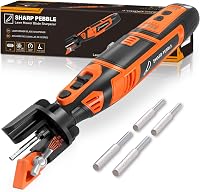
Sharp Pebble Cordless Lawn Mower Blade Sharpener
9.6/10 our score
See it on Amazon -
3
 Best for adjustable jig use
SporGain [Updated] Lawn Mower Blade Sharpener 15°-45°
9.4/10 our score
See it on Amazon
- 4
 Check it
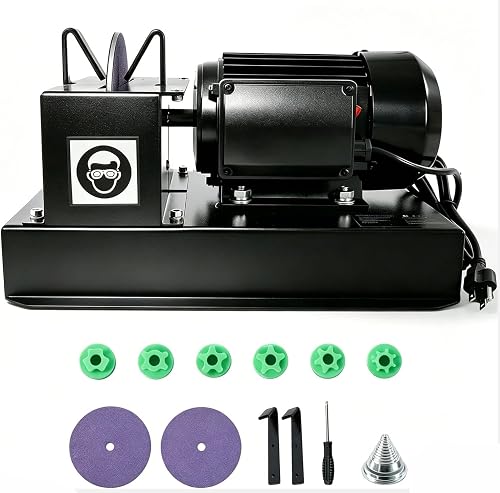
Holdwell S Lawn Mower Blade Sharpener
Best for 1HP bench power - 5
 Check it
SporGain Lawn Mower Blade Sharpener
Best for brushless motor control - 6
 Check it
VEVOR Lawn Mower Blade Sharpener
Best for balanced 1HP grinding - 7
 Check it
VEVOR Lawn Mower Blade Sharpener
Best for dual wheel options - 8
 Check it
Jinlida JLD10-8 Lawn Mower Blade Sharpener
Best for compact bench grinding - 9
 Check it
SporGain Updated Lawn Mower Blade Sharpener
Best for light brushless setups
The best mower blade sharpeners for bench grinders
Dedicated bench grinders lead this list because they hold angle and power steady.
Jigs and cordless tools follow for buyers without a free bench or for light maintenance.
Bench grinders in this group use fixed wheels and motor power that stay constant from pass to pass.
That constant power matters when a blade is dull along most of its length and needs even stock removal.
A jig or cordless tool can maintain an edge, but it cannot match the same sustained grinding force.
RBG Mower Blade Sharpener: Best for preset angle grinding
- 1/2 HP motor
- 7 inch 24 grit ceramic/steel wheel
- Preset 30-degree blade guide
- 1725 rpm
A dedicated bench disc grinder with a preset 30-degree guide for standard and reverse left-hand blades.
Pros
- Preset guide holds angle
- Fast aggressive wheel
- Simple setup
Cons
- Single preset angle
- No balancer in kit
The RBG suits buyers who want one correct angle every time.
Its preset 30-degree guide removes guesswork for standard right-hand and reverse left-hand blades.
The 1/2 HP motor runs at 1725 rpm with a 7 inch, 24 grit ceramic and steel wheel.
That coarse wheel cuts metal fast, so light passes matter more than pressing hard.
It measures 17 by 11.5 by 11 inches and weighs less than the 1HP bench models here.
The alloy steel body and grey finish reflect a bench tool built for workshop use rather than yard use.
Power comes from a corded electric supply at 110 volts and 600 watts.
Simple assembly and easy setup save time before the first blade.
RBG gives a 1-year warranty for added cover on the motor and frame.
The trade-off is a single preset angle with no balancer in the kit.
If you need 40 degrees or a balance check, a Holdwell or VEVOR model gives more options.
Sharp Pebble Cordless Lawn Mower Blade Sharpener: Best for cordless touch-ups
- Cordless, 5,000-30,000 RPM variable speed
- 20 to 40 degree adjustable guide
- 1.41 lb weight
- For standard residential blades
A light cordless sharpener for quick on-mower touch-ups on standard residential blades.
Pros
- No cord or bench needed
- Adjustable angle
- Light to carry
Cons
- Not for heavy-duty or zero-turn blades
- Not a grinder for damaged edges
Sharp Pebble suits buyers who want to sharpen where the mower sits.
It is cordless and 1.41 lb, so you can carry it one-handed to the mower.
Variable speed runs from 5,000 to 30,000 RPM with an adjustable guide from 20 to 40 degrees.
Tighten the guide firmly and recheck it every few strokes for even geometry.
Sharp Pebble says routine touch-ups take about 2 to 3 minutes per blade.
One full charge sharpens 1 to 2 standard residential blades.
Blade removal is often optional on standard residential blades, which saves disassembly time.
A dull blade tears grass instead of cutting it, and a clean cut helps the lawn recover faster.
The compact size at 8 by 2.8 by 1.2 inches makes storage simple in a garage drawer or shed.
The trade-off is clear.
It is for standard residential blades only, not zero-turn or heavy-duty commercial blades.
It also will not fix chips or deep dents, since it is a sharpener, not a grinder.
SporGain [Updated] Lawn Mower Blade Sharpener 15°-45°: Best for adjustable jig use
- 15 to 45 degree adjustable frame
- Fits 1.65 to 3.60 inch wide blades
- Ball bearing and 4 adapter screws for angle grinder
- 25mm handle
An adjustable jig that holds blades steady while you use most angle grinders at 15 to 45 degrees.
Pros
- Wide angle range
- Fits many blade widths
- Works with most angle grinders
Cons
- Needs your own angle grinder
- Manual thumb screw setup
SporGain suits buyers who already own an angle grinder.
This is a jig, not a motor, and it holds the blade while your grinder does the cutting.
The frame adjusts from 15 to 45 degrees with thumb screws.
It fits blades from 1.65 to 3.60 inches wide, including straight, mulching and high-lift types.
A ball bearing, 25mm handle and 4 adapter screws help it fit most angle grinders.
The holder secures the blade so angle stays fixed during a pass.
At 2.95 lb and 13.5 by 9 by 3.4 inches, it stores easily on a shelf.
You fix it to a table or workbench, then set the angle before you start.
That bench mounting reduces wobble compared with holding a blade by hand.
The trade-off is setup time.
You must mount it, set the angle and fit your grinder before each session.
Our best mower blade sharpener for angle grinder guide covers that separate route in more detail.
Holdwell S Lawn Mower Blade Sharpener: Best for 1HP bench power
- 1HP 750W motor
- 9 inch 60 grit ceramic wheel
- 30 and 40 degree brackets
- Balancer and 6 hole adapters
A heavy 1HP bench grinder with 30 and 40 degree brackets, a balancer and adapters for many blade types.
Pros
- Strong 1HP motor
- Includes balancer
- Fits high, low, gator and flat blades
Cons
- Heavy at 43.1 lb
- Bench space required
Holdwell S suits buyers who want full bench power with extras in the box.
Its 1HP 750W motor drives a 9 inch, 60 grit ceramic wheel for fast stock removal.
Pre-installed 30 degree and extra 40 degree brackets cover different blade types.
It works with high-lift, low-lift, gator and flat blades.
The kit includes extra replacement sandpapers, a blade balancer and 6 blade hole adapters.
Those adapters help the blade sit stable and non-slip during sharpening.
The aluminium housed motor helps with heat dissipation during longer sessions.
A solid steel base and integrated design reduce vibration and keep the unit stable.
Simple 3-step assembly includes a screwdriver and user manual for ready use.
The trade-off is weight and space.
At 43.1 lb and about 17 by 12 by 10 inches, it needs a solid bench.
It is a poor pick for storage in a small shed.
SporGain Lawn Mower Blade Sharpener: Best for brushless motor control
- Brushless motor, adjustable to 3000RPM
- 30 and 45 degree guides
- 10 pcs 60 grit and 60 pcs 180 grit discs
- Lifetime motor warranty
A brushless bench sharpener with variable speed, coarse and fine discs, and 30 and 45 degree guides.
Pros
- Adjustable speed
- Fine and coarse discs included
- Lifetime motor warranty
Cons
- Discs need replacement over time
- Lighter than dedicated grinders
SporGain suits buyers who want speed control without a full 1HP bench grinder.
Its brushless motor adjusts to 3000RPM, so you can slow down for fine work.
It includes 10 pcs 60 grit discs for grinding and 60 pcs 180 grit discs for fine sharpening.
The 30 and 45 degree guides help lock angle for high lift, low lift, gator and flat blades.
At 15.77 lb, it is far lighter than the Holdwell and VEVOR bench models.
The compact footprint at 10.91 by 7.68 by 13.58 inches fits smaller workbenches.
Brushless power is described as stronger with lower noise and longer lifespan than traditional motors.
SporGain backs the motor with a lifetime motor warranty.
Easy assembly makes it suitable for home or workshop use across common blade types.
The trade-off is disc wear.
Sanding discs need replacement over time, and you lose the solid bench grinder feel.
Learn the motion first with How To Use Lawn Mower Sharpener?
VEVOR Lawn Mower Blade Sharpener: Best for balanced 1HP grinding
- 1HP motor, 1725RPM
- 9 inch ceramic grinding wheel
- 30 and 40 degree sharpening
- Grit collector and balancer
A 1HP bench grinder with a 9 inch ceramic wheel, grit collector and balancer for 30 and 40 degree work.
Pros
- 1HP power
- Balancer included
- Grit collector helps cleanup
Cons
- Heavy at 42.1 lb
- Fixed bench footprint
VEVOR suits buyers who want 1HP power with a balancer and cleaner work.
Its 1HP motor and 9 inch ceramic wheel restore dull edges quickly.
It offers 30 and 40 degree blade sharpening for high lift, low lift, gator and flat blades.
A grit collector helps keep dust down around the bench.
The included balancer lets you check the blade after sharpening.
That check helps reduce vibration and engine wear from uneven removal.
The motor runs at 1725RPM in manual operation mode with a power supply.
At 42.1 lb and about 15.71 by 12.4 by 9.4 inches, the weight helps hold the unit steady.
Regular sharpening with this setup improves mowing efficiency and reduces equipment wear over time.
The silver finish and compact depth suit a standard bench position.
The trade-off is size.
Buyers with limited space may prefer the lighter SporGain brushless models.
VEVOR Lawn Mower Blade Sharpener: Best for dual wheel options
- 1/2HP motor
- 7 inch flap wheel and 9 inch ceramic wheel
- 30 or 40 degree sharpening
- For high, low, gator and flat blades
A 1/2HP dual wheel bench grinder that pairs a 7 inch flap wheel with a 9 inch ceramic wheel.
Pros
- Two wheel types
- 30 and 40 degree options
- Lighter than 1HP models
Cons
- Less motor power
- No balancer listed
VEVOR suits buyers who want two wheel types on one bench unit.
It pairs a 7 inch flap wheel with a 9 inch ceramic grinding wheel on a 1/2HP motor.
That dual wheel setup lets you choose between flap and ceramic action for different stages of work.
It supports 30 or 40 degree sharpening for high lift, low lift, gator and flat blades.
At 34.4 lb, it is lighter than the 1HP VEVOR model and the Holdwell S.
The dimensions at 14.96 by 12.4 by 11.02 inches still require a fixed bench spot.
Regular use can restore worn and dull blades to a sharp cutting edge.
The dual wheel design gives more choice than a single wheel bench grinder.
It still needs a power supply and a stable bench mount for safe use.
The trade-off is lower motor power and no balancer listed in the data.
If balance matters to you, the 1HP VEVOR or Holdwell S gives you that tool in the kit.
Jinlida JLD10-8 Lawn Mower Blade Sharpener: Best for compact bench grinding
- 2/3HP 500W, 1700 rpm
- 7 inch 60 grit ceramic wheel
- 30 degree holder, plus 40 degree holders
- Balancer and 5 sanding discs
A compact 500W bench grinder with a 7 inch ceramic wheel, balancer and five replaceable discs.
Pros
- Balancer included
- Replaceable discs
- Compact footprint
Cons
- Lower power than 1HP picks
- Fewer angle options in main holder
Jinlida suits buyers who want a compact bench grinder with a balancer.
Its 500W motor runs at 1700 rpm with a 7 inch, 60 grit ceramic wheel.
A 30 degree tool holder helps keep grinding angle precise.
The kit also includes 2 40 degree knife holders for alternate angles.
It comes with 5 replaceable 60 grit discs and 1 metal balancer.
The steel base and integrated structure help stability during DIY and professional use.
At 32 lb and 16.93 by 12.6 by 9.45 inches, it is smaller than the 1HP models.
The adjustable mounting system helps fit most standard lawn mower blades.
Replaceable discs extend service life as the ceramic surface wears.
The trade-off is power.
At 2/3HP, it trails the 1HP models for thick or badly worn blades.
It is a good fit for standard blades and regular maintenance.
SporGain Updated Lawn Mower Blade Sharpener: Best for light brushless setups
- Brushless motor to 3000RPM
- 30 and 45 degree guides
- 3 pcs 60 grit and 60 pcs 180 grit discs
- Lifetime motor warranty
A lighter brushless sharpener with variable speed and coarse and fine discs for home workshops.
Pros
- Light at 13.9 lb
- Adjustable speed
- Lifetime motor warranty
Cons
- Fewer coarse discs than sibling model
- Not a full bench grinder
SporGain Updated suits buyers who want the lightest brushless option here.
At 13.9 lb, it is easy to move between bench and storage.
Its brushless motor reaches 3000RPM with adjustable speed.
You get 30 and 45 degree guides for high lift, low lift, gator and flat blades.
The kit includes 3 pcs 60 grit discs and 60 pcs 180 grit discs for coarse and fine stages.
SporGain backs the motor with a lifetime motor warranty.
The footprint at 10.91 by 7.68 by 13.58 inches matches the other brushless model.
Lower speed helps control heat on fine edges, while higher speed speeds up grinding.
Easy assembly suits home workshops where bench space is limited.
The trade-off is fewer coarse discs than the B0H74X3NHW model.
It is also a sharpener kit, not a heavy bench grinder, so badly damaged blades may need a grinder first.
Side by side: bench grinders, jigs and cordless sharpeners
| Product | Best for | Horsepower | Wheel | Angle guide | Our score |
|---|---|---|---|---|---|
| RBG Mower Blade Sharpener | preset angle grinding | 0.5 hp | 7 inch, 24 grit | 30 degrees preset | 9.7 |
| Sharp Pebble Cordless Lawn Mower Blade Sharpener | cordless touch-ups | 20 to 40 degrees | 9.6 | ||
| SporGain [Updated] Lawn Mower Blade Sharpener 15°-45° | adjustable jig use | 9.4 | |||
| Holdwell S Lawn Mower Blade Sharpener | 1HP bench power | 1 HP | 9 inch, 60 grit ceramic | 9.2 | |
| SporGain Lawn Mower Blade Sharpener | brushless motor control | 8.9 | |||
| VEVOR Lawn Mower Blade Sharpener | balanced 1HP grinding | 1 HP | 9 inch ceramic | 8.7 | |
| VEVOR Lawn Mower Blade Sharpener | dual wheel options | 1/2 HP | 8.5 | ||
| Jinlida JLD10-8 Lawn Mower Blade Sharpener | compact bench grinding | 7 inch, 60 grit ceramic | 8.2 | ||
| SporGain Updated Lawn Mower Blade Sharpener | light brushless setups | 8.0 |
We compared motor type, wheel size and grit, angle guides, blade compatibility, included balancers, weight and warranty from the product data.
Dedicated bench grinders scored highest for repeat angle control and stock removal.
Jigs scored well for angle range and blade fit, but they depend on a grinder you already own.
Cordless models scored well for portability, but they suit only standard residential blades.
Weight tells a clear story in this group.
The 1HP bench models weigh over 42 lb, while the brushless kits weigh under 16 lb.
That weight gap affects stability, storage and how often you will actually use the tool.
Warranty also differs by setup.
RBG lists a 1-year warranty, while both SporGain brushless models list a lifetime motor warranty.
What the comparison does not show
The table does not show how a worn wheel or disc changes cutting speed.
A fresh 24 grit wheel will remove metal faster than a worn 60 grit wheel.
Replaceable discs and extra sandpapers help you plan for that wear.
How we compared these mower blade sharpeners
We checked specs for motor power, RPM, wheel diameter and grit, angle range and blade width.
We also checked what each kit includes, such as balancers, adapters, discs and guides.
We did not test these tools.
Scores reflect how well the stated specs and features match bench grinder sharpening needs.
We weighted angle control heavily because uneven angles cause uneven edges.
We weighted motor power next because dull blades need sustained cutting force.
We weighted included tools such as balancers because balance affects vibration after refitting.
We weighted weight and size because a tool that does not fit your bench will stay unused.
Blade fit mattered for the jig in particular, since width and centre hole size change the setup.
How to read the scores
Higher scores reflect a stronger match for bench grinder sharpening, not a lab test result.
A dedicated grinder with a preset guide scores higher for repeat work than a touch-up tool.
A jig scores higher for angle range, but lower for needing separate power.
What angle guide should you use for bench grinder sharpening?
Which angle guide fits your blades?
30 degrees is the default for most factory edges.
The RBG preset guide, Holdwell 30 degree bracket and VEVOR 30 degree settings all target that standard.
30 and 40 degree guides
Holdwell S and both VEVOR bench models offer 30 and 40 degrees.
That choice helps if your blades were ground at 40 degrees or you want a different edge geometry.
30 and 45 degree guides
Both SporGain brushless models use 30 and 45 degree guides.
The wider jump suits buyers who sharpen several blade types.
15 to 45 and 20 to 40 degree ranges
The SporGain jig adjusts from 15 to 45 degrees in small steps.
Sharp Pebble adjusts from 20 to 40 degrees for cordless touch-ups.
Match the guide to your blade, then keep it fixed.
Changing angle mid-blade creates an uneven edge.
Why angle stays fixed on a bench grinder
A preset guide removes hand movement from the process.
The blade meets the wheel at the same angle on every pass.
That repeatability helps keep both cutting edges even.
Freehand grinding can drift, especially as the blade gets warm.
How much motor power do you need?
Is 1HP better than 1/2HP for mower blades?
1HP suits heavy stock removal, while 1/2HP suits regular maintenance.
The Holdwell S and VEVOR 1HP models both use 9 inch ceramic wheels.
1HP bench grinders
Holdwell S uses a 750W motor.
VEVOR uses a 1HP motor at 1725RPM.
Both models weigh over 42 lb, which helps stability.
1/2HP and compact motors
RBG uses 1/2 HP at 1725 rpm.
Jinlida uses 500W at 1700 rpm.
Those motors suit dull edges more than deep damage.
Brushless variable speed
SporGain models adjust to 3000RPM.
Lower speed helps control heat and fine edges, while higher speed speeds up grinding.
Power versus control
More power removes metal faster, but it also builds heat faster.
Light passes with a 1HP motor often work better than heavy pressure.
A 1/2HP motor rewards patience and keeps the edge cooler.
What wheel size and grit matter most?
Which wheel is best for mower blade sharpeners?
A coarse ceramic wheel removes metal fast, while fine discs finish the edge.
RBG uses 24 grit, while Holdwell, Jinlida and VEVOR use 60 grit ceramic wheels.
7 inch wheels
RBG and Jinlida use 7 inch wheels.
VEVOR dual wheel model pairs a 7 inch flap wheel with a 9 inch ceramic wheel.
9 inch wheels
Holdwell S and VEVOR 1HP use 9 inch ceramic wheels.
Larger wheels cover more blade surface per pass.
Sanding discs for fine work
SporGain kits add 180 grit discs for fine sharpening.
That second stage can smooth the edge after coarse grinding.
Grit choice in daily use
Coarse grit suits dull or worn edges that need stock removed.
Fine grit suits touch-ups where the edge is already close to shape.
Using coarse grit for fine work can leave a rough edge.
Using fine discs alone may take too long on a badly dull blade.
Do you need a balancer and blade adapters?
Should you buy a sharpener with a balancer?
Yes, if you grind both sides of a blade.
Uneven removal can cause vibration, and a balancer shows the heavy side before you refit the blade.
Holdwell S includes a balancer and 6 hole adapters.
VEVOR 1HP includes a balancer and grit collector.
Jinlida includes a metal balancer.
The SporGain jig fits 1.65 to 3.60 inch wide blades without a balancer listed.
Sharp Pebble also has no balancer listed.
Before you refit a blade, read How to Change Lawn Mower Blades? and How to Remove a Lawn Mower Blade? for safe removal and refit steps.
Adapters and centre holes
Blade centre holes vary by mower brand and blade type.
Adapters help the blade sit centred and stable on the grinder.
Holdwell S includes 6 adapters for that reason.
A loose fit can cause chatter and uneven grinding.
Balance checks after grinding
Check balance after you finish both edges.
Remove a little metal from the heavy side if needed.
Recheck before you refit the blade to the mower.
Bench grinder, angle grinder jig or cordless sharpener: which setup wins?
What is the best mower blade sharpener for bench grinders by setup?
A dedicated bench grinder wins for repeat work, a jig wins for angle range, and a cordless tool wins for portability.
Your bench space and blade type decide the winner.
Dedicated bench grinder
RBG, Holdwell, VEVOR and Jinlida are true bench grinders.
They hold angle, power and wheel steady for full sharpening.
Angle grinder jig
The SporGain 15 to 45 degree jig needs your own angle grinder.
It is lighter and cheaper to store than a 42 lb bench unit.
Cordless sharpener
Sharp Pebble is fastest for on-mower touch-ups.
It cannot replace a grinder for chips, dents or missing metal.
For a wider view of handheld options, see Best Lawn Mower Blade Sharpeners.
Storage and bench space
A 43 lb bench grinder needs a fixed spot with power nearby.
A 2.95 lb jig fits in a drawer and can move to any workbench.
A 1.41 lb cordless tool fits in a small carry case.
Choose the setup you will store safely and use often.
Verdict: best mower blade sharpeners for bench grinders
Pick the RBG if you want a preset 30 degree guide and fast coarse grinding.
Pick Holdwell S or VEVOR 1HP if you want a 9 inch ceramic wheel, 30 and 40 degree options and a balancer.
Pick the SporGain jig if you already own an angle grinder and want 15 to 45 degree control.
Pick Sharp Pebble for cordless touch-ups on standard residential blades only.
Pick SporGain brushless models if you want variable speed, fine discs and a lighter setup.
Check blade width, center hole size and bench space before you order.
Match the motor to the job, with 1HP for heavy removal and 1/2HP for maintenance.
Match the wheel to the edge, with coarse ceramic for dull blades and fine discs for finishing.
Keep the angle fixed for the full blade to avoid an uneven cut.
Check balance before refitting to reduce vibration and engine wear.
Our top 3 picks at a glance
-
1
-
2
Best for cordless touch-ups
Sharp Pebble Cordless Lawn Mower Blade Sharpener
9.6/10 our score
See it on Amazon -
3
Best for adjustable jig use
SporGain [Updated] Lawn Mower Blade Sharpener 15°-45°
9.4/10 our score
See it on Amazon
Frequently asked questions
What is the best mower blade sharpener for bench grinders?
The RBG is the best dedicated pick for preset 30 degree grinding. The Holdwell S and VEVOR 1HP models suit buyers who want a larger 9 inch ceramic wheel and a balancer.
Can I use a regular bench grinder for mower blades?
You can, but you must hold the same angle on every pass. A guide or jig helps keep the edge even and reduces the risk of overheating one spot.
What angle should I use for mower blades?
Many factory edges sit near 30 degrees. Some guides here offer 30 and 40 degrees, or 30 and 45 degrees, so match the guide to your blade and keep it consistent.
Do I need a balancer after sharpening?
Yes, uneven removal can cause vibration. Several models here include a balancer, and you should check balance before you refit the blade.