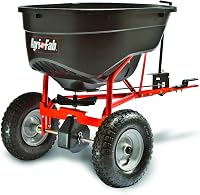
8 Best Broadcast Fertilizer Spreaders (November 2026)
The best broadcast fertilizer spreaders include the Scotts Turf Builder EdgeGuard DLX Broadcast Spreader for most homeowners, the Agri-Fab Pull Behind Broadcast Spreader for Seed for riding mowers, and the VEVOR Walk Behind Spreader 60 lbs Capacity for adjustable control.
On this page (8 sections)
- Our top broadcast fertilizer spreaders, ranked by score
- Comparison of broadcast mechanisms, hopper sizes and flow controls
- How large a lawn can each hopper cover?
- Walk behind, push, tow behind or hand: which type fits you?
- How do flow controls and spread widths affect even coverage?
- What is the best broadcast spreader for fertilizer on small lawns?
- How do you set up and care for a broadcast spreader?
- Which broadcast spreader should you buy for fertilizer?
The best broadcast spreader for fertilizer for most homeowners is the Scotts Turf Builder EdgeGuard DLX Broadcast Spreader, because it is pre-calibrated, covers up to 15,000 sq. ft., and keeps product off driveways with EdgeGuard. Our score weighs specs, features and buyer feedback against what you are shopping for.
You need capacity, pattern control and flow control in that order. A wide pattern means little if you keep stopping to refill, and a large hopper means little if the flow setting dumps too much in one spot.
This guide compares walk behind, push, tow behind and hand models. We looked at hopper size, spread width, tire size and control type, then matched each model to a lawn size and job.
Start with our fertilizer spreader buying guide if you are still deciding between spreader types. For night and day coverage questions, see how to use a broadcast spreader evenly.
Our picks at a glance
-
1
 Best for most homeowners
Scotts Turf Builder EdgeGuard DLX Broadcast Spreader
9.7/10 our score
See it on Amazon -
2
 Best for riding mowers
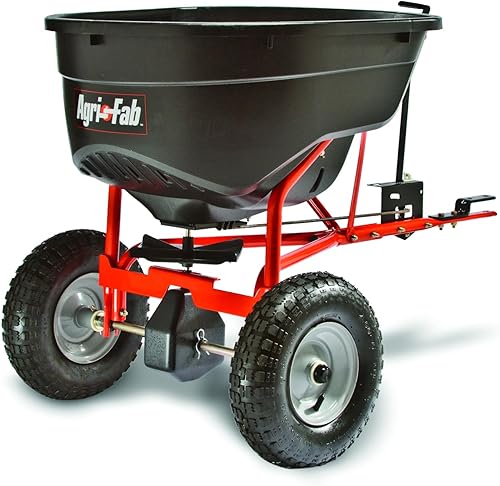
Agri-Fab Pull Behind Broadcast Spreader for Seed
9.6/10 our score
See it on Amazon -
3
 Best for adjustable control
VEVOR Walk Behind Spreader 60 lbs Capacity
9.4/10 our score
See it on Amazon
- 4Check it
VEVOR Push Lawn Spreader 80 lbs Capacity
Best for wider push coverage - 5
 Check it
EarthWay 2150 Commercial 50 LB Broadcast Fertilizer
Best for heavy duty use - 6
 Check it
Amazon Basics Broadcast Fertilizer Spreader for Lawn
Best for light seasonal jobs - 7
 Check it
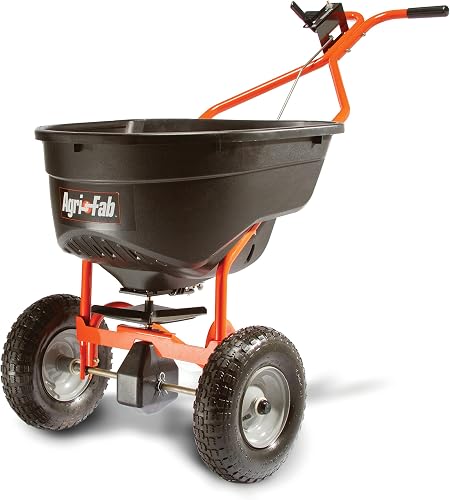
Agri-Fab 45-0614 130 lb. Push Lawn
Best for large walk behind loads - 8
 Check it
Jonathan Green Hand Broadcast Lawn Spreader
Best for spot treatment
Our top broadcast fertilizer spreaders, ranked by score
The Scotts leads for ease and edge control, while the Agri-Fab tow behind leads for large riding mower yards. The middle picks trade hopper size, pattern width and tire size in different ways.
Scotts Turf Builder EdgeGuard DLX Broadcast Spreader: Best for most homeowners
- EdgeGuard Technology
- Pre-calibrated, no assembly required
- Covers up to 15,000 sq. ft.
- For seed, fertilizer, salt and ice melt
Pre-calibrated Scotts spreader with EdgeGuard side control for clean edges on smaller and mid-size lawns.
Pros
- Pre-calibrated and ready to use
- EdgeGuard blocks one side of the pattern
- Light at 10.9 pounds
Cons
- Smaller hopper than 60 lb and 130 lb models
- Best matched to Scotts product settings
The Scotts Turf Builder EdgeGuard DLX suits homeowners who want a ready to use spreader without calibration guesswork. It covers up to 15,000 sq. ft. per load, which fits many suburban lawns in one or two fills.
EdgeGuard Technology blocks the right side of the pattern when you engage it. That helps keep fertilizer off landscaping, driveways and sidewalks along edges.
Scotts says the spreader arrives pre-calibrated and needs no assembly. If you use a Scotts drop model, see using a Scotts drop spreader.
You set the rate control dial to the setting on the back of the product bag, fill the hopper, and start.
The curved hopper and dual-bladed agitator help granules funnel smoothly. That matters with seed and ice melt as well as fertilizer, because clumping causes uneven coverage.
At 10.9 pounds, it is light to lift into storage. The trade-off is hopper size, since 60 lb, 80 lb and 130 lb models here need fewer refills on larger lawns.
Best for most homeowners who use Scotts products and want clean edges. Choose a larger hopper if your lawn is closer to half an acre.
Agri-Fab Pull Behind Broadcast Spreader for Seed: Best for riding mowers
- 130 lb hopper
- 10 to 12 ft spread width
- Universal hitch
- For seed, fertilizer, salt and ice melt
Tow behind Agri-Fab with a 130 lb hopper and universal hitch for riding mowers and lawn tractors.
Pros
- Large 130 lb hopper
- Wide 10 to 12 ft pattern
- Universal hitch fits most riding mowers
Cons
- Needs a riding mower or lawn tractor
- Larger storage footprint than walk behind models
The Agri-Fab Pull Behind Broadcast Spreader suits owners of riding mowers and lawn tractors with large yards. Its 130 lb hopper covers up to 1/2 acre or 25,000 sq. ft. with fewer refills.
The universal hitch connects to most riding lawn mowers and lawn tractors. Agri-Fab names Craftsman, Husqvarna and Cub Cadet among the brands it fits.
A 10 ft to 12 ft spread width covers ground in fewer passes. That wide pattern helps on open, rectangular lawns where you can make long straight runs.
Flow control from the tractor seat lets you adjust settings without stopping. That helps keep application steady across a long pass.
Construction uses 1 in steel tubing, an enclosed gear house, a poly hopper and 13 in x 4 in pneumatic tires. Those details matter for repeated seasonal use on rough ground.
The trade-off is storage and towing space. You need a riding mower, a flat storage area and room to turn with a tow behind unit.
Best for riding mower owners with half acre or larger lawns. Skip it if you only have a walk behind mower or a small yard.
VEVOR Walk Behind Spreader 60 lbs Capacity: Best for adjustable control
- 60 lb capacity
- 0 to 9.8 ft spreading width
- 18 adjustable settings
- 8 in pneumatic tires
Walk behind VEVOR with 18 settings and a 0 to 9.8 ft pattern for precise coverage on home lawns.
Pros
- 18 adjustable settings
- 60 lb hopper cuts refill trips
- No tools required for assembly
Cons
- Narrower pattern than 12 ft models
- Smaller hopper than 80 lb and 130 lb models
The VEVOR Walk Behind Spreader 60 lb model suits home lawns and small farms where precise pattern control matters. It spreads from 0 to 9.8 ft with 18 adjustable settings.
That range lets you narrow the pattern near beds and widen it in open areas. The disc pellet controller helps adjust flow in small steps rather than one fixed opening.
A 60 lb hopper holds a full bag in many cases, which cuts refill trips. You can finish a mid-size lawn with fewer stops than with a 5 lb or 50 lb model.
The frame is powder-coated steel and the hopper is explosion-proof plastic. VEVOR says the build resists UV corrosion and impact during outdoor use.
You get 8 in pneumatic tires for grass, gravel and snow. Smaller tires roll less smoothly than 10 in or 13 in tires on rough turf, but they keep the unit compact.
Assembly needs no tools, which helps first time owners. Best for adjustable control on home lawns where pattern width changes from pass to pass.
VEVOR Push Lawn Spreader 80 lbs Capacity: Best for wider push coverage
- 80 lb capacity
- 12 ft spreading width
- 15 adjustable settings
- 10 in pneumatic tires
Push VEVOR with an 80 lb hopper and 12 ft width for fewer passes on larger walk behind jobs.
Pros
- 12 ft spread width
- 80 lb hopper
- 15 adjustable settings
Cons
- Heavier to push when full than lighter models
- Wider pattern needs care near edges
The VEVOR Push Lawn Spreader 80 lb model suits walk behind users who want a wider pattern than the 60 lb VEVOR. It spreads 12 ft with 15 adjustable settings.
The 12 ft width means fewer passes across open lawn. That saves time on larger yards, but you need clear edges because granules will land near beds and paths.
An 80 lb hopper reduces refilling during spring seeding and summer fertilizing. It also handles salt and ice melt in winter, so one tool covers four seasonal jobs.
For more precise salt placement, compare drop spreaders for salt.
The powder-coated steel frame and explosion-proof hopper resist UV and rust. Key parts come pre-assembled, with no drilling required for setup.
You get 10 in pneumatic tires that adapt to uneven ground better than 8 in tires. The handle and hopper detach for split storage when space is tight.
The trade-off is push weight when full. An 80 lb load plus a 19.18 pound unit takes effort on slopes and soft soil.
Best for wider push coverage on mid to large walk behind lawns. Choose the 60 lb VEVOR if you prefer a narrower pattern.
EarthWay 2150 Commercial 50 LB Broadcast Fertilizer: Best for heavy duty use
- 50 lb poly hopper
- 13 in pneumatic stud tires
- 3-hole drop system with side spread control
- Adjustable drop rate
EarthWay 2150 with 13 in tires and 3-hole drop control for rough turf and repeat seasonal use.
Pros
- Large 13 in pneumatic tires
- 3-hole drop with side control
- Adjustable handle height
Cons
- 50 lb hopper needs more refills than 130 lb models
- Heavier frame at 25 pounds
The EarthWay 2150 Commercial 50 LB model suits buyers who push over rough, uneven turf. It uses 13 in pneumatic stud tires that roll over bumps with less effort.
The 50 lb poly hopper is rust proof and impact resistant, and it washes down easily after use. That size holds a full bag yet fits in tight storage spaces.
EarthWay uses a 3-hole drop system with side spread control. You can adjust the drop rate on the spreader and feather the edges for more accurate placement.
A clog free grate separates large pieces that could block the hopper outlet. It slides in and out when you do not need it for a given product.
The enclosed gearbox and stainless steel linkage help in moist conditions without cables that stick. The multi-position height-adjustable handle fits operators of different heights.
At 25 pounds before product, it is heavier than the Scotts and VEVOR models. Best for heavy duty use on rough lawns where tire size and drop control matter most.
Amazon Basics Broadcast Fertilizer Spreader for Lawn: Best for light seasonal jobs
- Covers 5,000 sq. ft. per load
- Multi-gear system
- 0.5 cubic ft capacity
- 33 pounds
Amazon Basics walk behind spreader covering 5,000 sq. ft. per load for seed, fertilizer, salt and ice melt.
Pros
- Covers 5,000 sq. ft. per load
- Multi-gear precision control
- Steel frame for all season use
Cons
- Smaller coverage per load than larger hoppers
- No stated spread width in the data
The Amazon Basics Broadcast Fertilizer Spreader suits lighter seasonal jobs on smaller lawns. It covers 5,000 sq. ft. in one load, which fits many front and back yards.
The multi-gear system gives precision control over flow. That helps you match seed, fertilizer, salt and ice melt without changing tools.
A steel frame and plastic bin stand up to all season weather use. The release cable comes pre-installed, which simplifies assembly compared with models that need cable routing.
At 33 pounds, this unit is heavier than the Scotts at 10.9 pounds and the Jonathan Green hand spreader at 1.4 pounds. Push weight matters more than empty weight once product is inside.
The 0.5 cubic ft capacity is modest. You will refill more often than with 60 lb, 80 lb or 130 lb models on larger yards.
Best for light seasonal jobs where one load covers most of the lawn. Choose a larger hopper if you fertilize more than 5,000 sq. ft. at a time.
Agri-Fab 45-0614 130 lb. Push Lawn: Best for large walk behind loads
- 130 lb capacity
- 10 to 12 ft spread
- 13 x 4 in pneumatic tires
- Direct rod control
Walk behind Agri-Fab with the same 130 lb, 1/2 acre capacity as the tow model, plus direct rod control.
Pros
- 130 lb hopper without a tractor
- 10 to 12 ft spread
- 13 in pneumatic tires
Cons
- Heavy when loaded with 130 lb
- Large footprint for storage
The Agri-Fab 45-0614 Push Lawn model suits walk behind users who want tow behind capacity without a tractor. It holds 130 lb and covers 1/2 acre, or 25,000 sq. ft.
The 10 to 12 ft spread width matches the tow behind Agri-Fab in this list. That wide pattern covers open lawn in fewer passes, but it needs care near edges and plantings.
Direct rod control makes flow adjustments simple. You can change the setting with the lever rather than bending to a dial.
You get 13 in x 4 in pneumatic tires for rolling over turf. Large tires help on uneven ground, especially when the hopper is full.
The trade-off is weight. A 130 lb load is hard to push on slopes, soft soil or long hills, even with large tires.
Storage also matters, since the unit measures 48 x 27.2 x 33.7 inches. Best for large walk behind loads on flat, open lawns where refill trips are the main pain point.
Jonathan Green Hand Broadcast Lawn Spreader: Best for spot treatment
- Covers up to 1,500 sq. ft.
- Holds up to 5 lb
- 10 ft broadcast width
- Ergonomic forearm handle
Handheld Jonathan Green spreader for bare spots, small areas and spot controls, covering up to 1,500 sq. ft.
Pros
- Only 1.4 pounds
- 10 ft broadcast width
- Ergonomic forearm handle
Cons
- 5 lb capacity means frequent refills
- Not suited to whole lawn fertilizing
The Jonathan Green Hand Broadcast Lawn Spreader suits spot work rather than whole lawn fertilizing. It covers up to 1,500 sq. ft. and holds up to 5 lb.
A 10 ft broadcast width sounds wide for a hand tool, but the 5 lb capacity means you refill a lot. That trade-off makes sense for bare spots, overseeding patches and spot controls.
The ergonomic handle lets your forearm support the weight. That design reduces back strain compared with carrying a bag and scooping by hand.
At 1.4 pounds, it is the lightest option here by far. You can carry it to a garden, driveway or sidewalk without effort.
It spreads seed, fertilizer, lawn controls and ice melt. Use it where a walk behind spreader would be too wide or too heavy for the job.
The limit is scale. Whole lawn coverage would take many refills and many passes.
Best for spot treatment on small areas, gardens and bare patches.
Comparison of broadcast mechanisms, hopper sizes and flow controls
Hopper size decides refill frequency, while spread width decides pass count. A 130 lb model can cover 25,000 sq. ft., while the hand spreader covers 1,500 sq. ft. per load.
| Product | Best for | Capacity | Model | Weight | Our score |
|---|---|---|---|---|---|
| Scotts Turf Builder EdgeGuard DLX Broadcast Spreader | most homeowners | Up to 15,000 sq. ft. | 76232 | 10.9 pounds | 9.7 |
| Agri-Fab Pull Behind Broadcast Spreader for Seed | riding mowers | 130 lb | 9.6 | ||
| VEVOR Walk Behind Spreader 60 lbs Capacity | adjustable control | 60 lb | 9.4 | ||
| VEVOR Push Lawn Spreader 80 lbs Capacity | wider push coverage | 80 lb | 9.2 | ||
| EarthWay 2150 Commercial 50 LB Broadcast Fertilizer | heavy duty use | 50 lb | 2150 | 8.9 | |
| Amazon Basics Broadcast Fertilizer Spreader for Lawn | light seasonal jobs | 0.5 cubic ft | 33 pounds | 8.7 | |
| Agri-Fab 45-0614 130 lb. Push Lawn | large walk behind loads | 130 lb | 8.4 | ||
| Jonathan Green Hand Broadcast Lawn Spreader | spot treatment | 5 lb | 1.4 pounds | 8.2 |
We compared each model by capacity, spread width, tire size and control type. We also checked weight, assembly needs and storage size, because those factors affect daily use.
Flow control varies by model. Scotts uses a rate control dial, VEVOR uses adjustable settings, EarthWay uses a 3-hole drop, and Agri-Fab uses rod control.
Broadcast mechanisms work the same way in principle. A spinner plate flings granules outward, and the width depends on spinner speed, opening size and product type.
Wider is not always better. A 12 ft pattern saves passes on open lawn but can waste product near edges, while a narrow pattern needs more passes but gives cleaner lines.
Tire size affects rolling effort. Models with 10 in or 13 in pneumatic tires roll over rough turf more easily than 8 in tires or small wheels.
How large a lawn can each hopper cover?
Match the hopper to your total lawn area, not just the front yard. A 5 lb hand spreader covers 1,500 sq. ft., while 130 lb models cover 25,000 sq. ft.
Small lawns under 5,000 sq. ft.
The Amazon Basics covers 5,000 sq. ft. per load, and the Jonathan Green covers 1,500 sq. ft. Those sizes suit small yards with fewer refills.
Small lawns also need edge control. A wide 12 ft pattern can overshoot beds, so a narrower or adjustable pattern helps.
Mid-size lawns from 5,000 to 15,000 sq. ft.
The Scotts covers up to 15,000 sq. ft., which fits many suburban yards in one load. The VEVOR 60 lb and 80 lb models also fit this range.
Mid-size yards benefit from refill savings. A 60 lb or 80 lb hopper means fewer trips back to the bag during seeding or fertilizing.
Large lawns over 15,000 sq. ft.
The Agri-Fab models with 130 lb hoppers cover 25,000 sq. ft. or 1/2 acre. That capacity suits large walk behind jobs and tow behind mowing.
Large lawns also reward wide patterns. A 10 to 12 ft spread cuts pass count when you have long straight runs.
Walk behind, push, tow behind or hand: which type fits you?
Choose by your mower and by how much you want to push. Walk behind models cover most homes, tow behind models need a riding mower, and hand models suit spots.
Walk behind broadcast spreaders
Walk behind models include the Scotts, both VEVOR units, the EarthWay and the Amazon Basics. They work with any mower and store in a garage corner.
Compare walk behind models by tire size and control type. Larger pneumatic tires help on rough turf, while dial, lever and rod controls adjust flow differently.
Tow behind broadcast spreaders
The Agri-Fab tow behind needs a riding mower or lawn tractor with a universal hitch. It suits half acre lawns where pushing a full hopper would take too long.
Tow behind use also needs turning room. Narrow gates and tight turns can make a pulled spreader awkward to maneuver.
Hand broadcast spreaders
The Jonathan Green hand spreader weighs 1.4 pounds and covers 1,500 sq. ft. It suits bare spots, gardens and small areas where a walk behind unit is overkill.
Hand spreaders need frequent refills. Use them for spot controls and overseeding patches rather than full lawn fertilizing.
How do flow controls and spread widths affect even coverage?
Flow control sets how much product leaves the hopper, while spread width sets where it lands. Both settings must match the product bag label.
Rate dials and adjustable settings
Scotts uses a rate control dial set to the number on the product bag. VEVOR models use 15 or 18 adjustable settings to change flow and width.
Those controls help you match seed, fertilizer and ice melt, because each product flows differently. Always check the bag label before your first pass.
Rod and lever controls
Agri-Fab models use direct rod control, and the tow behind model allows adjustment from the seat. That helps you change settings without stopping on long passes.
Rod controls also help on slopes where flow can change with speed. Slower walking can increase application rate, so adjust as you go.
Side control and edge guards
EarthWay uses side spread control, and Scotts uses EdgeGuard. Those features keep product off driveways, sidewalks and beds along edges.
Edge control matters most on lawns with planting beds. Without it, granules collect in beds and on pavement where they can wash away.
What is the best broadcast spreader for fertilizer on small lawns?
A pre-calibrated walk behind with edge control is best for small lawns. The Scotts EdgeGuard blocks one side of the pattern, which keeps edges clean.
For small lawns, see what is the best fertilizer spreader for small lawns. That guide covers narrow patterns and drop spreader options for tight areas.
Small lawns also need less hopper capacity. A 5,000 sq. ft. load or a 15,000 sq. ft. load can cover the whole yard without repeated refills.
If your lawn has many beds and curves, a drop spreader for lawn may give cleaner edges than a broadcast pattern. Some yards use both tools for different areas.
How do you set up and care for a broadcast spreader?
Set the flow control from the product label, then walk at a steady pace. Steady speed gives more even coverage than fast or slow bursts.
Set up before you fill
Check the rate setting on the product bag before you pour product into the hopper. Scotts models use the number on the back of each Scotts product.
Read how to use scotts fertilizer spreader for dial settings and EdgeGuard use. That guide explains the Scotts setup step by step.
Walk pattern and overlap
Walk in straight lines and overlap passes slightly at the edges. Overlap helps prevent stripes where patterns meet.
Slow down on turns, because granules keep flowing while you change direction. Shut off flow before you turn, then reopen when you start the next pass.
Cleaning and storage after use
Empty leftover product back into its bag after each job. Leftover granules left in the hopper can absorb moisture and clump.
Wash the hopper and spinner after use, and let it dry before storage. Store the spreader indoors, and check tire pressure on pneumatic tires before the next season.
If a wheel starts to wobble or drag, check best seed spreader wheels for replacement options. Good wheels keep the pattern steady and reduce pushing effort.
Which broadcast spreader should you buy for fertilizer?
Pick the Scotts EdgeGuard DLX for most homeowners, the Agri-Fab tow behind for riding mower yards, and the Agri-Fab push model for large walk behind lawns. Those three cover the main needs in this list.
Choose the VEVOR 60 lb if you want 18 settings and a 0 to 9.8 ft pattern. Choose the VEVOR 80 lb if you want a 12 ft pattern and fewer passes.
Choose the EarthWay 2150 if rough turf and 13 in tires matter most. Choose the Amazon Basics if one 5,000 sq. ft. load covers your yard.
Choose the Jonathan Green hand spreader only for spot work. Its 5 lb capacity and 1.4 pound weight make it ideal for patches, not whole lawns.
The best broadcast spreader for fertilizer is the one you will use at the right rate, at a steady walking pace, with the pattern set for your lawn edges. Match hopper size to yard size, and you will refill less and spread more evenly.
Our top 3 picks at a glance
-
1
Best for most homeowners
Scotts Turf Builder EdgeGuard DLX Broadcast Spreader
9.7/10 our score
See it on Amazon -
2
Best for riding mowers
Agri-Fab Pull Behind Broadcast Spreader for Seed
9.6/10 our score
See it on Amazon -
3
Best for adjustable control
VEVOR Walk Behind Spreader 60 lbs Capacity
9.4/10 our score
See it on Amazon
Frequently asked questions
What is the best broadcast spreader for fertilizer?
The Scotts Turf Builder EdgeGuard DLX leads this list for most homeowners because it is pre-calibrated and covers up to 15,000 sq. ft. per load. Choose a 60 lb to 130 lb walk behind if you want fewer refills, or the Agri-Fab tow behind if you use a riding mower.
How large a hopper do I need?
Match hopper size to lawn size and refill tolerance. A 5 lb hand spreader suits spots, 50 lb to 80 lb suits most walk behind jobs, and 130 lb suits half acre lawns or tow behind use with fewer stops.
Broadcast or drop spreader for fertilizer?
Broadcast spreaders fling granules in a wide pattern and cover ground faster. Drop spreaders place granules in a narrow line for precise edges.
Many yards benefit from a broadcast spreader for open areas plus careful edge work.