Spreaders & Sprayers: The Complete Buying Guide
Pick a broadcast fertilizer spreader for most open lawns, a drop spreader for tight edges, a handheld spreader for small areas, and a tow-behind model for large yards. Match hopper size and spread width to your lawn, and match sprayer tank and nozzle type to the liquid you plan to apply.
On this page (11 sections)
- Which fertilizer spreader type fits your lawn?
- How do you size a fertilizer spreader for lawn area and hopper capacity?
- What features should you compare on a walk-behind fertilizer spreader?
- How do handheld spreaders and shakers fit into lawn care?
- What should you know about tow-behind and tractor spreaders?
- How do you choose a lawn sprayer and understand nozzle types?
- Which products in this guide suit which jobs?
- How do you set up, use and store a spreader or sprayer?
- What are the most common spreader and sprayer mistakes?
- How should you compare spreaders and sprayers before you buy?
- Which spreader or sprayer should you buy first?
Pick a broadcast fertilizer spreader for most open lawns, a drop spreader for tight edges, a handheld spreader for small areas, and a tow-behind model for large yards. Match hopper size and spread width to your lawn, and match sprayer tank and nozzle type to the liquid you plan to apply.
A fertilizer spreader does one job well. It feeds granules at a steady rate, over a steady width, so the lawn gets an even dose.
Hand spreading can work for one small patch, but it rarely keeps the same rate across a whole yard. That uneven rate can leave stripes, thin spots and wasted product on pavement.
This guide is the main hub for the spreaders and sprayers category on Over Top Info. It links to every topic cluster we cover, from drop and broadcast models to handheld shakers, tow-behind units, backpack sprayers and replacement parts.
Use the sections below to pick the right tool, then follow the linked guides for setup, use and care.
Which fertilizer spreader type fits your lawn?
Choose by lawn shape first, then by lawn size. Open rectangular lawns suit broadcast models, while narrow strips and lawns with many beds suit drop models.
A broadcast spreader uses a spinning plate or rotor to throw granules outward. It covers ground fast, which helps on open lawns.
It also needs care near edges, because granules can land on driveways, sidewalks and flower beds. Edge guards and deflector shields help, but they do not remove the need for straight passes and clean turns.
A drop spreader releases granules through chutes below the hopper. The pattern falls straight down, so you can keep product on the lawn and off hard surfaces.
For winter paths, see drop spreaders for salt.
That control is useful along fences, gardens and sidewalks. The trade-off is more passes, because the pattern is narrower than a comparable broadcast model.
Handheld spreaders and shakers fill the gap for small lawns, garden beds, spot seeding and winter salt. They hold less material and cover less ground per refill, but they store in a small space and cost less to own.
A shoulder-bag style can work when you walk the area and shake product by hand, so read our guide to the fertilizer spreader bag if you want that carry style.
Tow-behind spreaders attach to a riding mower or lawn tractor. Follow our guide to using a tow-behind spreader for setup and operation.
They suit large, open yards where walking passes would take too long.
Their hoppers hold more material, and their spread widths cover more ground per pass. They need a tractor, a hitch, space to turn and a dry place to store a larger frame.
If you are still deciding between the two main walk-behind types, our broadcast spreader vs drop spreader comparison walks through pattern, edges and pass count in more detail.
How do you size a fertilizer spreader for lawn area and hopper capacity?
Size the hopper to cover your lawn with few refills, but not so large that you struggle to push or store it. A hopper that covers 15,000 sq ft suits many home lawns, while a 130 lb tow-behind hopper suits about 1/2 acre.
Capacity is usually stated in pounds or in square feet of coverage. Square feet of coverage is easier to use, because it already links the load to a lawn size.
Pounds of capacity still matter, because some granules are denser than others and a full hopper has real weight.
Measure your lawn before you buy. Split it into simple rectangles, multiply length by width for each one, and add the results.
Subtract large beds, patios and driveways if you will not spread there. That total tells you whether a handheld shaker, a walk-behind hopper or a tow-behind hopper fits best.
For small yards, a handheld unit with an 80 oz hopper can cover a patch or a small lawn with a few refills. The refill stops are part of the work, but they also let you check coverage as you go.
For a mid-size lawn, a walk-behind broadcast hopper that holds enough for 15,000 sq ft can cover the whole yard in one load. For a large yard, a tow-behind hopper rated for about 25,000 sq ft or 1/2 acre reduces refill stops during long passes.
If your lawn is small and you want model ideas before you choose a size, start with What Is the Best Fertilizer Spreader for Small Lawns?. If you want to see which walk-behind models are on sale, check the best fertilizer spreader on sale roundup for current options in that size range.
What features should you compare on a walk-behind fertilizer spreader?
Compare spread width, rate control, hopper shape, wheels and edge control before you compare brand names. Those features decide how evenly granules fall and how easy each pass feels.
Spread width sets how much ground one pass covers. A wider pattern means fewer passes, but it also means more care at the edges.
A narrower pattern means more passes, but it gives you tighter control. Rate control sets how much product leaves the hopper.
Look for a clear dial or lever, and for markings that match the settings printed on fertilizer bags.
Hopper shape matters more than it sounds. A smooth, curved hopper helps granules funnel toward the opening without bridging.
An agitator or spinner helps keep flow steady as the level drops. When product flows in surges, the lawn gets stripes.
When it flows at a steady rate, coverage stays even.
Wheels affect effort and tracking. Larger wheels roll over rough ground more easily, and pneumatic tires can soften bumps better than hard plastic.
If you want a model built for that ride, look at the best fertilizer spreader with pneumatic tires options. Frame weight also matters, because you push the spreader when it is full and lift it when you load it.
Edge control helps on lawns that meet driveways, sidewalks or beds. Some broadcast models use a side shield that blocks one side of the pattern.
Others use a deflector or a drop chute. If your lawn has many straight edges, that feature can save you more time than a wider pattern.
Brand-specific guides can help once you narrow the field. Our best earthway fertilizer spreader roundup covers one common brand line, and our parts guide for best earthway spreader parts covers repairs when a spinner, belt or wheel wears out.
How do handheld spreaders and shakers fit into lawn care?
Handheld spreaders suit small lawns, spot seeding, garden beds and winter salt on paths. They trade capacity for control, light weight and easy storage.
A handheld shaker usually holds about 80 oz, which is enough for a patch, a strip or a path. You fill it, set the opening size, and walk the area while shaking or cranking.
The opening size sets the flow rate, so a small opening suits fine seed and a larger opening suits salt or coarse granules.
The Yhtpouqe handheld model uses a rotating lid with three opening sizes, from small to large. That lets you change particle size without changing tools.
It also includes a scoop for filling and a pair of garden gloves, which helps when you handle salt or fertilizer. Its screw top helps keep material dry and prevents spills in a closet or car.
The Bacetuao shaker uses a precision flow dial and a build of plastic and stainless steel. It targets the same small to medium areas, with an ergonomic shape meant to reduce hand fatigue during longer walks.
Both of these 80 oz shakers weigh just over 1 lb empty, so they are easy to carry and store.
If you want more handheld choices, our best handheld lawn spreader roundup compares shaker and crank styles. For seed work in particular, see our best handheld seed spreader guide and our best grass seed spreader picks, because seed size changes the opening you need.
What should you know about tow-behind and tractor spreaders?
Tow-behind spreaders suit large, open yards and reduce walking time, but they need a compatible tractor and room to turn. Check the hitch, hopper size and spread width before you buy.
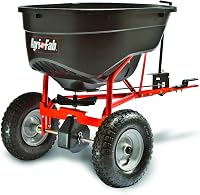
The Agri-Fab tow-behind model in this guide has a 130 lb hopper and a spread width of 10 ft to 12 ft. That width covers open ground with fewer passes than a walk-behind model.
Its universal hitch connects to most riding lawn mowers and lawn tractors, including Craftsman, Husqvarna and Cub Cadet models. The hopper is poly, the frame uses 1 in steel tubing, and the tires are 13 in by 4 in pneumatic tires.
A steel rod flow control lets you adjust the setting from the tractor seat. That helps when you cross a path or enter a new section of lawn.
An enclosed gear house protects the gears from dirt and moisture. Those details matter on a tow-behind model, because it works over larger areas and at higher speed than a walk-behind unit.
Tow-behind models also suit more than fertilizer. The same hopper can spread grass seed, lawn treatments, salt and ice melt across a wide area.
If you mainly spread salt or ice melt with a tractor, read our guide to a fertilizer spreader for tractor and our picks for best broadcast spreaders for salt.
Size is the main trade-off. A tow-behind frame measures about 33.63 in deep by 27 in wide by 48 in high, so it needs real storage space.
It also needs a turning area at the end of each pass. On a small or narrow lawn, a walk-behind model will be easier to use.
On a large open yard, the tow-behind model can cut the job down to a few long passes.
Check your tractor manual before you order. Hitch type, ground clearance and tire size all affect fit.
Our seed spreader wheel guide also covers best seed spreader wheels if you need to replace pneumatic tires after season use.
How do you choose a lawn sprayer and understand nozzle types?
Choose a sprayer by tank size, pump type and nozzle type, then match the nozzle to the product label. Those three choices set coverage, pressure and droplet size.
Backpack sprayers carry the tank on your back, which frees your hands and spreads the weight across both shoulders. Handheld pump sprayers suit small areas and spot work, because you carry the tank in one hand and pump with the other.
Tank sprayers with a larger capacity suit bigger lawns, because they hold more liquid between refills.
Pump type affects pressure. A manual pump builds pressure each time you stroke the handle, so output can vary as pressure drops.
A battery powered pump holds a steadier pressure with less effort. Neither type is right for every job.
Manual pumps are simple and light, while battery pumps suit longer passes where steady output matters.
Nozzle type shapes the spray pattern. Flat fan nozzles lay down a wide, even band and suit most lawn applications.
Cone nozzles concentrate more liquid near the center and suit spot treatments or shrubs. Stream nozzles send a narrow jet and suit a single weed or plant.
Some sprayers include several nozzle tips, so you can swap patterns without buying a new sprayer.
Droplet size also matters. Larger droplets drift less in wind, but they may cover less evenly.
Smaller droplets cover more evenly, but they drift more. The product label sets the nozzle and pressure to use, so follow it first and use your judgment second.
For liquid lawn work, start with our best backpack lawn sprayers picks, then learn how to use garden pump sprayer models for smaller jobs. If you want a larger tank, compare best lawn sprayer with tank options, and keep our best pump sprayer replacement parts guide for seals, nozzles and hoses when they wear.
Which products in this guide suit which jobs?
Match the product to the job, not to the highest score alone. Each model below fits a different lawn size and material.
The Scotts Turf Builder EdgeGuard DLX Broadcast Spreader suits mid-size lawns that need seed, fertilizer, salt or ice melt from one walk-behind tool. It holds enough product for up to 15,000 sq ft, comes pre-calibrated and needs no assembly.
Its EdgeGuard shield blocks the right side of the pattern, which helps keep granules off landscaping, driveways and sidewalks. Its curved hopper and dual-bladed agitator help granules funnel smoothly for consistent coverage.
The Agri-Fab Pull Behind Broadcast Spreader suits large yards and all-season use with a riding mower or lawn tractor. Its 130 lb hopper covers up to 1/2 acre or 25,000 sq ft with fewer refills.
Its 10 ft to 12 ft spread width reduces passes, and its universal hitch fits most riding mowers and tractors. It spreads seed, fertilizer, salt and ice melt, so it can handle spring seeding and winter salt from one tool.
The Yhtpouqe Hand held Spreader suits small areas where a walk-behind model is too much tool. Its 80 oz hopper reduces refill stops for a handheld unit.
Its three opening sizes handle seed, fertilizer, salt and ice melt, and its ergonomic handle aims to reduce wrist fatigue. It includes a scoop and one pair of garden gloves, and its screw top helps prevent spills.
The Bacetuao Hand Spreader Shaker suits similar small to medium areas with a simpler setup. Its 80 oz capacity, flow dial and light ergonomic shape make it easy to carry through garden beds, lawns and driveways.
Its plastic and stainless steel build targets outdoor use in harsh conditions. Choose it if you want a flow dial rather than a rotating lid with fixed openings.
If your lawn is open and mid-size, the Scotts model is the safer first pick. If your yard is large and you already own a riding mower, the Agri-Fab model earns its space.
If your job is a patch, a path or winter salt, one of the handheld shakers will be easier to store and use.
How do you set up, use and store a spreader or sprayer?
Set the rate before you fill the hopper, walk at a steady pace, and clean the tool after each use. Those three habits prevent most uneven coverage and early wear.
Start with a dry, empty hopper or tank. Read the product label for the rate setting, nozzle type and pressure.
Set the rate dial or opening size while the tool is empty, so you can see the mark clearly. Fill the hopper or tank away from the lawn edge, so spills land where you can sweep them up.
Walk in straight lines at a steady pace. Overlap passes by about half a pattern width, so granules or liquid fall evenly.
Slow down at turns, because a slow turn with the spinner still on drops extra product in one spot. Shut the flow at the end of each pass, then reopen it at the start of the next pass.
For a Scotts walk-behind model, turn the rate control dial to the setting listed on the back of the product bag, pour product into the hopper, and start spreading. For a drop spreader, keep the chutes centered on the lawn and watch the edges.
For a handheld shaker, set the opening size for the particle in the hopper, then shake at a steady rhythm as you walk.
For sprayers, pump or charge the tank to the pressure in the label, then spray in steady passes. Keep the nozzle at a steady height, because height changes the band width.
Stop spraying in wind, because drift moves product off the lawn and onto beds or vegetables.
Clean after each use. Empty leftover granules into a sealed bag, knock loose material from the hopper, and wipe the spinner, agitator or deflector.
Rinse a sprayer tank, pump, hose and nozzle with clean water, then let parts dry before storage. Store a spreader under cover and a sprayer with the tank empty, because standing moisture can rust metal parts and clog nozzles.
For model-specific steps, read how to use scotts fertilizer spreader, how to use scotts drop spreader and how to mount a sprayer on a lawn mower. If you plan to spread compost, compare best compost spreaders for lawns.
If you want powered help for granules, see best battery powered spreader options and best broadcast spreader for fertilizer picks for wider passes.
What are the most common spreader and sprayer mistakes?
Most mistakes come from the wrong rate, the wrong pattern or a dirty tool. Fix those three, and coverage improves fast.
The first mistake is guessing the rate. Fertilizer bags list a setting for each spreader type, and that setting is a starting point, not a suggestion.
A setting that suits a broadcast model will not suit a drop model. Use the setting printed for your exact spreader type, then check coverage by walking the lawn after the first pass.
The second mistake is walking too fast or too slow. A spreader spreads evenly only at a steady pace.
Rushed passes drop too little product, and slow or stopped passes drop too much. Keep the same pace across the whole lawn, and shut the flow when you stop to open a gate or move a hose.
The third mistake is ignoring wind. Wind pushes broadcast granules and spray droplets off target.
On a windy day, granules can land on pavement and droplets can drift into beds. Wait for a calm window, and use a narrower pattern or a larger droplet size when the label allows it.
The fourth mistake is storing a dirty or wet tool. Leftover fertilizer can cake in a hopper, and leftover liquid can clog a nozzle or damage seals.
Empty, rinse or wipe the tool after each use, then let it dry. That short step prevents clogs and keeps the flow rate steady next time.
The fifth mistake is using one tool for every job. A handheld shaker cannot cover a large lawn efficiently, and a tow-behind spreader is too large for a narrow strip.
Match the tool to the area, the material and the edges. That match matters more than extra features.
How should you compare spreaders and sprayers before you buy?
Compare pattern, capacity, controls and storage size side by side, then pick the tool that fits your lawn and materials. That short list will narrow the field faster than brand names alone.
Write down your lawn size, the materials you will spread and the edges you need to protect. Note whether you own a riding mower or tractor, and where you will store the tool.
Those five facts rule out half the options in a store or online catalog.
Next, compare spread width and hopper capacity. A wide pattern suits open lawns, while a narrow pattern suits tight edges.
A larger hopper means fewer refills, but it also means more weight to push or lift. For sprayers, compare tank size, pump type and included nozzle tips.
A larger tank means fewer refills, but it also means more weight to carry.
Then compare controls. A clear rate dial, a flow lever you can reach from the handle and an edge shield all help during a real pass.
For sprayers, a pressure gauge, a lockable trigger and spare nozzle tips help you keep output steady. Simple controls you can read at a glance beat extra features you cannot use mid-pass.
Finally, compare storage size and parts support. A tow-behind frame needs more room than a handheld shaker, and a backpack sprayer needs a dry shelf.
Check whether replacement wheels, belts, seals or nozzles are easy to find before you buy. A tool with ready parts will serve you longer than a slightly cheaper tool with none.
Use the cluster guides above to compare models by job. Start with best broadcast spreader for fertilizer for open lawns, drop spreader for lawn for tight edges, and best handheld lawn spreader for small areas.
For liquid work, compare best backpack lawn sprayers and best lawn sprayer with tank options.
Which spreader or sprayer should you buy first?
Buy a walk-behind broadcast fertilizer spreader first if you own a mid-size open lawn, a drop spreader if edges matter most, and a handheld shaker if your area is small. Add a tow-behind model or a sprayer only when your lawn size or materials demand it.
For most readers, the Scotts Turf Builder EdgeGuard DLX Broadcast Spreader is the safest first buy in this guide. It holds enough for up to 15,000 sq ft, needs no assembly, and its EdgeGuard shield helps on lawns with driveways and sidewalks.
It also handles seed, fertilizer, salt and ice melt, so one tool covers several seasons.
Choose the Agri-Fab tow-behind model if your lawn is large, open and already mowed with a riding mower or tractor. Choose a handheld shaker, such as the Yhtpouqe or Bacetuao models above, if your main jobs are spot seeding, garden beds, paths or winter salt.
Choose a sprayer when your product is liquid. A backpack sprayer suits larger liquid jobs, while a handheld pump sprayer suits small areas and spot work.
Match the nozzle to the label, clean the tank after each use, and store it dry.
Keep this guide as your hub for the spreaders and sprayers category. Use the linked guides to compare types, learn setup steps and find parts when you need them.
The right fertilizer spreader is the one whose pattern, capacity and controls fit your lawn, your materials and the space where you store it.
Frequently asked questions
Which fertilizer spreader is best for most home lawns?
A walk-behind broadcast spreader suits most home lawns because it covers open areas quickly and evenly. Choose a drop spreader when you need tighter control near beds, driveways or sidewalks.
Choose a handheld or tow-behind model when your lawn size or material makes those options more practical.
What is the difference between a broadcast spreader and a drop spreader?
A broadcast spreader throws granules in a wide arc, so it covers open lawn quickly with fewer passes. A drop spreader releases granules straight down in a narrow pattern, so it gives you more control near edges.
The right choice depends on lawn shape, nearby surfaces and how much overlap you can tolerate.
What sprayer nozzle types should lawn owners know?
Flat fan nozzles spread liquid in a wide, even band for lawn coverage. Cone nozzles put more liquid in the center and suit spot work.
Stream nozzles send a narrow jet for a single plant or weed.
Match nozzle size and pressure to the product label before you spray.
How often should you clean a fertilizer spreader or sprayer?
Clean a spreader after each use by emptying leftover granules, knocking loose material from the hopper and wiping the spinner or agitator. Rinse a sprayer tank, pump, hose and nozzle after each use and let parts dry before storage.
Stored dry and clean, both types last longer and spread more evenly.