How to Use a Tow-Behind Spreader
To use a tow behind spreader, connect the hitch, set the rate from the product label, load the hopper, drive at a steady speed, and overlap each pass by half the spread width. Start with the flow closed, open it at the edge, and close it before you turn.
On this page (11 sections)
- What do you need before you hitch up the spreader?
- How do you hitch a tow behind spreader to your mower?
- How do you set the application rate correctly?
- How do you load the hopper without wasting product?
- How do you make the first pass and read the pattern?
- How do you plan towing passes for even coverage?
- How should you handle turns, obstacles, and edges?
- How do you calibrate a spreader for a new product?
- How do you clean, store, and maintain the spreader?
- When is a tow behind spreader the wrong tool?
- Which spreader fits your lawn and your mower?
To use a tow behind spreader, connect the hitch, set the rate from the product label, load the hopper, drive at a steady speed, and overlap each pass by half the spread width. This guide covers setup, calibration, passes, turns, and clean-up so material lands evenly.
A tow behind spreader saves time on medium and large lawns because the mower does the walking. Even coverage comes from the right setting, a steady speed, and overlap.
What do you need before you hitch up the spreader?
You need the spreader, a compatible mower or tractor, product, and the rate setting from the product label. Read the label before loading anything, because each product calls for a different rate.
Check that your mower has a hitch point made for a tow behind implement. A fertilizer spreader for tractor guide can help you match hitch and weight to your machine.
Do not pull a heavy loaded spreader with a mower not rated for towing. Gather gloves, a scoop or funnel, and a broom for clean-up.
Keep children and pets away while you hitch, load, and drive. Park on flat ground with the engine off before connecting or disconnecting.
Fill the hopper only after you confirm the setting, as loading first makes it easy to set the rate for the wrong product.
How do you hitch a tow behind spreader to your mower?
Hitch the spreader level behind the mower, with the pin secured and the tow bar at the height the maker specifies. A level spreader throws a level pattern, while a tilted spreader can throw more to one side.
Back the mower straight up to the spreader and line up the hitch holes. Insert the pin and clip or locking pin.
Tug gently to confirm the hitch holds, then check that wheels and spinner turn freely.
Our guide on How To Tow A Lawn Mower? covers hitch safety, turning, and backing with a towed load. Read it before your first pass if you have not towed anything before.
Keep the hopper load within the spreader limit and the mower limit, whichever is lower.
How do you set the application rate correctly?
Set the rate from the number on the product label, not from a guess or a past season. The label states how many pounds to apply per 1,000 square feet and the spreader setting that delivers that rate.
Turn the rate control dial or lever to that setting before you load the hopper. On many models the setting is marked on the hopper or on a chart.
If your spreader has no chart, use the test area method described below.
Do a short test run on a measured area when you try a new product. Spread over a known distance, weigh what left the hopper, and adjust the setting if the rate is off.
The Scotts Turf Builder EdgeGuard DLX Broadcast Spreader holds up to 15,000 sq. ft. of product and comes pre-calibrated. Its EdgeGuard shield blocks the right side of the pattern near beds and driveways.
It suits walk-behind use, so use it for edges and small areas around a tow behind run.
How do you load the hopper without wasting product?
Load the hopper after the rate is set, with the flow closed, and only with material the spreader can handle. Keep the spin plate and outlets clear of clumps, because clumps cause gaps in the pattern.
Pour product slowly and break up clumps with your glove before they enter the hopper. Damp fertilizer and salt can clump in storage.
For winter walkway coverage, compare broadcast spreaders for salt.
Dry, free-flowing granules spread more evenly than damp ones.
Do not overfill past the fill line. A full hopper can spill on turns and can strain the hitch.
Leave space at the top so material does not bounce out on rough ground.
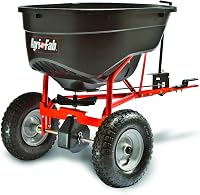
The Agri-Fab Pull Behind Broadcast Spreader for Seed has a 130 lb hopper and covers up to 25,000 sq. ft. with one fill. Its universal hitch fits most riding lawn mowers and lawn tractors.
The wide spread pattern means fewer passes, but it needs open space to work well.
How do you make the first pass and read the pattern?
Make the first pass along the longest straight edge, with the flow closed until you reach the start line. Open the flow as you cross the line, drive straight, and close the flow before you reach the end.
Watch the pattern behind you on your first pass. Broadcast spreaders throw a wide fan, so you can see whether the fan is level and centered.
If one side throws farther, check the level of the spreader and the spinner height. Mark your start and stop lines with cones, flags, or paint.
A clear line helps you open and close the flow at the same spot on every pass. Start driving before you open the flow, and stop the flow before you stop driving, to prevent a heavy pile of product at each end.
How do you plan towing passes for even coverage?
Plan passes so each row overlaps the last by about half the spread width. If the spreader throws 10 ft, space rows about 5 to 6 ft apart.
This overlap fills the thin edges of each fan.
Drive rows in one direction first, then cross-spread at a half rate if the label allows it. Use half the label rate in each direction so product lands from two directions and hides small gaps.
Keep speed steady down each row. The spinner throws material based on wheel and engine speed, so surging and slowing change the rate.
Our fertilizer spreader buying guide explains spread widths, hopper sizes, and pattern types. Use it to match a spreader to your lawn size before you buy.
How should you handle turns, obstacles, and edges?
Handle turns by closing the flow before the turn, slowing down, and reopening after you are straight on the next row. Open flow during a turn piles product in a circle and leaves the next row short.
Plan a headland, which is a strip at each end where you turn without spreading. Make the headland wide enough for your mower and spreader to turn in.
Spread the headland last, working from the center outward.
Use a drop pattern or a walk-behind spreader near beds, gardens, and driveways. A tow behind drop spreader drops material straight down in a narrow line, which suits edges where a broadcast fan would waste product.
For salt-specific choices, see drop spreaders for salt.
The Yhtpouqe Hand held Spreader holds up to 80 Oz and has three adjustable opening sizes. It suits sidewalks, driveways, and small bare spots.
Use it for salt and ice melt on paths, for seed in small patches, and for fertilizer in garden beds.
How do you calibrate a spreader for a new product?
Calibrate by spreading a measured area, weighing the product used, and adjusting the setting until the rate matches the label. This test works for any granular product and any spreader brand.
Measure a test area, such as 100 sq. ft. Weigh the hopper before and after the test pass.
Multiply the weight used by the number of test areas in your lawn to find the total rate, then compare it with the label rate.
Adjust the rate control a small amount and repeat the test. Write the setting down for that product so you can repeat it next season.
Check What Is the Best Fertilizer Spreader for Small Lawns? if your yard is small enough that a tow behind model is more than you need.
How do you clean, store, and maintain the spreader?
Clean the spreader after each use, with the flow closed and the hopper empty, to stop clumping and rust. Empty leftover product back into a sealed bag or container and label it.
Brush out the hopper, spinner, and outlets with a dry brush. Wash with water only if the maker allows it, then dry the parts fully.
Fertilizer and salt left in a damp hopper can rust steel parts and seize the spinner.
Store the spreader indoors or under cover, with the flow closed. Keep the hitch pin and clip with the spreader so the next setup starts fast.
Check tires, bolts, and the spinner for wear before the next season.
When is a tow behind spreader the wrong tool?
A tow behind spreader is the wrong tool when the lawn is too small, too steep, or too full of obstacles for safe towing. In those cases, a walk-behind or handheld spreader gives better control.
Steep slopes can make a towed load push the mower downhill. Wet ground can cause wheel spin and uneven speed.
If you cannot drive steady rows, the pattern will not be even no matter how good the setting is.
Choose from the best heavy duty tow behind spreader picks if you need a large hopper and wide pattern for open ground. Choose from best tow behind spreader for zero turn mower picks if your mower is a zero turn.
Which spreader fits your lawn and your mower?
Pick the Agri-Fab tow behind model if you have an open half acre or more and want fewer refills and fewer passes. Its 130 lb hopper, 12 ft spread width, and pneumatic tires suit large, flat lawns.
Pick the Scotts EdgeGuard model if you need a walk-behind tool for edges and smaller areas. Its shield keeps product off driveways and beds, and its pre-calibrated dial speeds setup.
Pick the Yhtpouqe handheld model if you want a light tool for spot work, salt, and small patches. Its 80 oz hopper and three opening sizes suit quick jobs without hitching up.
For how to use a tow behind spreader on your own lawn, set the label rate, overlap each pass by half the width, and keep a steady speed.
Frequently asked questions
How fast should I drive when using a tow behind spreader?
Drive at a steady walking pace for most lawn tractors, keeping the speed consistent on every pass. A steady speed helps the spinner throw material evenly, since changes in speed change the amount of product per square foot.
Slow down before turns and reopen the flow only after you are straight again.
Do I need to overlap passes with a tow behind spreader?
Yes, overlap each pass by about half the spread width to avoid stripes. Broadcast spreaders throw less material at the edges of the pattern than in the center.
Overlap fills those thin edges, while a small gap leaves visible lines where the lawn gets too little product.
Can I use a tow behind spreader for grass seed?
Yes, many tow behind broadcast spreaders handle seed, fertilizer, salt, and ice melt. Check the product label for the rate and setting for seed, since seed needs a different flow setting than fertilizer.
Use a wider, slower pass for seed so the small pieces land evenly across the soil.
What is the difference between a broadcast and a drop spreader?
A broadcast spreader throws material in a wide arc behind the machine, while a drop spreader drops material straight down in a narrow line. Broadcast models cover ground faster on open lawns.
Drop models place product more precisely near beds, driveways, and garden edges, but need more passes.