How to Choose a Drop Spreader for Salt
A drop spreader for salt is best when you need a narrow, controlled line of salt on a path, driveway edge, or lawn border. Pick a model by spread width, flow control, hopper size, and how easily you can shut the flow off at edges.
On this page (11 sections)
- Why does a drop spreader for salt help on narrow paths?
- How do you measure the width you actually need?
- What flow control should a drop spreader for salt have?
- Which capacity fits your driveway and sidewalk?
- How does edge control protect lawns and planting beds?
- When is a broadcast spreader a better choice than a drop spreader?
- How do you set up and calibrate a salt spreader?
- How do you use a drop spreader for salt on ice?
- How should you clean and store a salt spreader?
- What mistakes should you avoid with salt spreaders for salt?
- Which drop spreader for salt should you buy for your home?
A drop spreader for salt gives you a narrow, controlled line instead of a wide fan of granules. That control matters on narrow paths and next to sensitive lawn edges.
You do not need the widest pattern for every job. You need salt where feet and tires travel, and much less salt on grass, garden beds, and drains.
A drop pattern helps you place it there.
We compared spreader types, checked the specs, and looked at how hopper size and flow control change daily use. Our score weighs specs, features and buyer feedback against what you're shopping for.
For a wider view of equipment, read our fertilizer spreader guide before you decide between drop and broadcast patterns. That guide explains when a standard spreader is enough.
Why does a drop spreader for salt help on narrow paths?
A drop spreader for salt helps because it drops granules in a tight band rather than throwing them sideways. That tight band suits a sidewalk, a front step, or the edge of a driveway.
Broadcast spreaders throw salt in a wide arc. That arc works well on a long driveway, but it can scatter salt onto a lawn strip you want to protect.
A drop pattern reduces that scatter.
Think about the shape of your treatment area first. A straight 3 ft walk needs a narrow line.
A wide driveway needs speed and coverage. The shape should drive the choice.
Flow control matters as much as pattern width. A small opening gives a light dusting for a light frost.
A wider opening gives a heavier dose for packed ice. You want both settings without swapping parts.
The Scotts model in that box uses EdgeGuard Technology to block one side of the pattern. That side shield is not a true drop pattern, but it gives similar edge control on a walk-behind unit.
Rule: choose a drop pattern when the treated strip is narrower than a broadcast fan, and choose broadcast when the area is wide and open.
How do you measure the width you actually need?
Measure the narrowest part of the path you treat. That measurement sets the maximum useful spread width.
A 9 ft driveway can take a wide pattern with room to spare. A 3 ft sidewalk cannot.
If the pattern is wider than the concrete, the extra salt lands on grass or soil.
Walk the path with a tape and note gates, steps, and curves. Curves often cause one side to get too much salt and the other side to get too little.
A narrow pattern makes curves easier to manage.
Test the pattern on a dry driveway before the first freeze. Make one short pass, look at the line, and change the setting if needed.
That short test saves salt and protects lawn edges all winter.
How wide is too wide for a lawn edge?
A pattern is too wide when it reaches grass while you are treating a path beside it. Look for granules on the lawn after a test pass, not just on the concrete.
If salt lands on grass, narrow the setting or use a side shield. The Scotts EdgeGuard system blocks the right side of its pattern for this exact use.
That VEVOR model lets you adjust spread width from 0 to 9.8 ft. The faster you push, the wider the spread, so a steady pace still matters.
Rule: set the pattern to the width of the concrete, and narrow it further at curves and lawn edges.
What flow control should a drop spreader for salt have?
Flow control sets how much salt leaves the hopper per step or per foot. A good control gives you a light setting for frost and a heavier setting for ice.
Look for a numbered dial or a clearly marked lever. Numbers help you repeat the same setting on the next storm.
A vague lever makes repeat settings hard.
The Scotts EdgeGuard DLX uses a rate control dial. You set the dial to the rate listed for the product, pour salt in the hopper, then start spreading.
Scotts says the unit comes pre-calibrated and ready to use.
The VEVOR walk-behind uses infinite adjustment with a 30-scale control system. That scale helps you record a setting that works for your sidewalk.
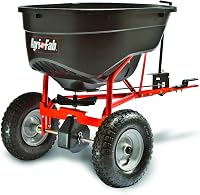
The Agri-Fab pull-behind uses a steel rod flow control that you adjust from the tractor seat. That seat control helps on large areas, but it is less handy on a short walk.
Rule: pick a spreader with a repeatable flow setting you can record and reset for each salt type.
Which capacity fits your driveway and sidewalk?
Capacity sets how far you can go before a refill. A small hopper suits a short walk.
A large hopper suits a long driveway and a second path.
The Scotts EdgeGuard DLX holds enough product for up to 15,000 sq ft of Scotts lawn products. Scotts lists salt and ice melt among its uses.
For a home sidewalk, that capacity means fewer trips back to the bag.
The VEVOR walk-behind has a 100 lb load capacity and a 56L hopper. That size covers large areas in one fill, but the filled weight makes it harder to push up a slope.
The Agri-Fab pull-behind has a 130 lb hopper and covers up to 25,000 sq ft with one fill. Agri-Fab says that is about one half acre.
A tow-behind unit makes sense only if you have a riding mower or tractor.
Do you need a push spreader or a tow-behind spreader?
A push spreader suits most homes with a driveway and a sidewalk. You control the pace and the shutoff at each edge.
A tow-behind spreader suits large properties with a riding mower. The Agri-Fab 45-0463 connects to most riding lawn mowers and lawn tractors, including Craftsman, Husqvarna, and Cub Cadet.
Tow-behind models spread 10 to 12 ft wide. That width is too wide for a narrow walk.
Use a tow-behind unit for open areas, then switch to a push or handheld unit for paths.
Rule: match capacity to your longest single route, and skip tow-behind models unless you own a riding mower or tractor.
How does edge control protect lawns and planting beds?
Edge control keeps salt on concrete and off grass, soil, and planting beds. That protection matters because salt on lawn edges can burn grass in winter.
The Scotts EdgeGuard DLX blocks the right side of its spread pattern when engaged. Scotts says that keeps lawn product off landscaping, driveways, and sidewalks.
You engage the shield on the lawn side and leave the concrete side open.
A true drop pattern achieves edge control by never throwing salt sideways. Granules fall close to the unit, so the line stays narrow.
That design suits a path between two lawn areas.
The VEVOR model narrows its pattern as low as 0 ft in width adjustment. A narrow setting helps at a bed edge, but you still need to walk the line carefully.
Edge control also saves money. Salt on grass does no work on ice, so it is wasted salt.
A tight pattern puts more of each bag where ice forms.
Rule: use a side shield or a narrow drop pattern on every pass that runs beside grass or a planting bed.
When is a broadcast spreader a better choice than a drop spreader?
A broadcast spreader is better when you need to cover a wide, open driveway fast. It throws salt in a wide fan and covers more ground per pass.
Our best broadcast spreader for salt roundup covers wide-pattern models for driveways. A drop spreader would take many more passes on that same driveway.
Broadcast units also handle uneven ice better. A wide fan can fill low spots that a narrow line might miss.
On a wide driveway, that even fill is worth the extra salt at the edges.
Use a drop pattern for walks, steps, and edges. Use a broadcast pattern for the center of a wide driveway.
Many homes end up using both patterns in one storm.
That Agri-Fab model suits open areas where width is an asset. It is not the right tool for a narrow front walk.
Rule: use broadcast for wide open areas and drop for narrow or edge-sensitive areas, even on the same property.
How do you set up and calibrate a salt spreader?
Set up a salt spreader by checking the hopper, setting the flow, and making a short test pass. That three-step routine prevents waste on the first storm.
First, check the hopper for leftover salt and moisture. Empty any wet clumps and wipe the hopper dry.
Wet salt clumps, then it jams the flow opening.
Second, set the dial to the rate for the salt or ice melt in the hopper. Scotts instructs users to turn the rate control dial to the correct setting listed for the product.
Use that same idea with any brand.
Third, make a test pass on a driveway or garage floor. Look at the line width and the density of granules.
Change the setting before you walk the full route.
The Scotts unit holds up to 15,000 sq ft of product and uses a curved hopper with a dual-bladed agitator. Scotts says that design helps with smooth product funneling and consistent coverage.
The VEVOR unit has a trapezoidal hopper and a hopper grate for seed, fertilizer, salt, and ice melt. The grate helps break clumps as you fill it.
Rule: calibrate on a test pass at your normal walking pace every time you change salt type.
How do you use a drop spreader for salt on ice?
Use a drop spreader for salt on ice by starting with a light, even line and adding more only where ice remains. Light frost needs much less salt than packed ice.
Start at the far end of the walk and work back toward the door. That route keeps you from walking over fresh salt and wearing it away before it melts ice.
Keep the flow open while you move and shut it off at each turn. A shutoff lever or dial at your hand makes that easy.
The Scotts EdgeGuard DLX puts the rate dial within reach as you walk.
On packed ice, make a second pass over the thickest spots. A second light pass melts ice more evenly than one heavy pass.
Heavy salt also leaves more residue on shoes and floors.
For steps, use a handheld unit or a bucket with a scoop. A walk-behind spreader is awkward on stairs, and it can spill salt off the tread.
Our best handheld salt spreader roundup covers those small, precise jobs. A handheld unit also suits porches, thresholds, and the edges a walk-behind model cannot reach.
Rule: start light, close the flow at turns, and add a second pass only on ice that remains.
How should you clean and store a salt spreader?
Clean a salt spreader after every use because salt corrodes metal and crusts moving parts. A quick rinse and dry cycle extends the life of the hopper, spinner, and gears.
Empty the hopper after the last pass. Store leftover salt in a dry bag or bucket, not in the hopper.
Salt left in a hopper absorbs moisture from the air.
Tap out loose granules, then rinse the hopper and spinner with clean water. Dry both parts with a cloth or towel.
The VEVOR model has a rust-resistant hopper and a sealed gearbox, but rinsing still helps.
Oil the spinner shaft and linkage lightly if the maker advises it. Do not over-oil, since excess oil traps grit.
The Agri-Fab model has a fully enclosed gear house to protect gears from grit.
Store the spreader on a dry shelf in a garage or shed. Keep it away from damp concrete floors.
A dry spot prevents rust on the frame and wheels.
The Agri-Fab model uses 1 in steel tubing, a poly hopper, and 13 in x 4 in pneumatic tires. Those materials handle outdoor use, but they still benefit from dry storage.
Rule: empty, rinse, dry, and store a salt spreader in a dry place after every winter use.
What mistakes should you avoid with salt spreaders for salt?
The most common mistake is setting the flow for fertilizer and using it for salt. Salt and fertilizer granules flow differently, so the dose will be wrong.
A second mistake is walking too slowly on curves. Slow walking piles salt on the inside of a turn and leaves the outside bare.
Keep a steady pace and shut off the flow at tight turns.
A third mistake is ignoring the lawn edge. Salt that lands on grass wastes product and can burn the lawn.
Use a side shield or a narrow pattern on edge passes.
A fourth mistake is leaving salt in the hopper all winter. Moisture turns that salt to sludge that jams the opening.
Empty the hopper and store the salt dry.
A fifth mistake is buying capacity you cannot push. A 100 lb hopper plus salt is heavy on a slope.
A smaller hopper with more refills is easier on your back.
For mower and yard tool context, see our guides on How To Choose A Good Lawn Mower? and How To Choose Lawn Mower?. Those guides help you size equipment to your property, much like sizing a spreader.
Rule: set the flow for the salt in the hopper, keep a steady pace, and never store salt in a damp hopper.
Which drop spreader for salt should you buy for your home?
Choose a drop spreader for salt by your narrowest path, your longest route, and the equipment you already own. Those three facts narrow the field fast.
Pick the Scotts Turf Builder EdgeGuard DLX if you want a walk-behind unit with side shield control. It holds up to 15,000 sq ft of product, comes pre-calibrated, and lists salt and ice melt among its uses.
Its 19 x 22 x 22 in size and 10.9 lb weight make it easy to store.
Pick the VEVOR Broadcast Spreader 100 lbs Capacity Walk-Behind if you want adjustable width from 0 to 9.8 ft. Its 100 lb capacity and 56L hopper cut refill trips, and its 13 in pneumatic tires handle uneven ground.
Its 32.2 lb unit weight means you should plan for a heavy filled load.
Pick the Agri-Fab Pull Behind Broadcast Spreader if you own a riding mower or tractor and treat a large lot. Its 130 lb hopper covers up to 25,000 sq ft, and its 10 to 12 ft pattern covers wide areas fast.
Its universal hitch fits most riding mowers, including Craftsman, Husqvarna, and Cub Cadet.
For narrow paths and sensitive lawn edges, a true narrow drop pattern still wins on control. For wide driveways, a broadcast pattern wins on speed.
Many homes need both, and a side shield bridges the gap.
Final rule: buy the narrowest pattern you can use comfortably, add a side shield for lawn edges, and size the hopper to your longest route without exceeding what you can push or tow.
Frequently asked questions
What is a drop spreader for salt?
A drop spreader for salt releases granules in a narrow pattern below the spinner path. It suits narrow paths and sensitive lawn edges where a wide broadcast pattern would waste salt or hit grass.
You still control the rate with a flow setting and your walking speed.
Is a drop spreader better than a broadcast spreader for salt?
A drop spreader is better when placement matters more than coverage speed. A broadcast spreader covers wide driveways faster, while a drop pattern keeps salt off lawns and planting beds.
Choose the pattern that matches the shape of the area you treat most often.
How wide should a salt spreader pattern be for a sidewalk?
For a sidewalk, a pattern close to the width of the walk keeps salt on concrete and off the lawn. Walk the edge first and set the flow low, then adjust after a short test pass.
A narrower pattern with even overlap usually beats a wide pattern with bare spots.
Can I use a fertilizer spreader for salt and ice melt?
Many fertilizer spreaders also handle salt and ice melt if the maker lists those uses. Salt can corrode metal parts, so clean the hopper and spinner after use.
Check the flow rate for salt rather than relying on a fertilizer setting.