How to Use a Scotts Drop Spreader
To use a Scotts drop spreader, set the flow control to the rate on the product label, fill the hopper, and walk steady, straight passes with the handle open only while moving. Close the handle at turns, overlap wheel tracks correctly for your model, and shut side shields near edges.
On this page (11 sections)
- How to use Scotts drop spreader controls before you start
- What rate setting should you use for seed, fertilizer, and salt?
- How do you plan passes for a drop spreader?
- Why does a drop spreader suit edges and narrow areas?
- How do you use the EdgeGuard side shield on a Scotts model?
- Which Scotts and similar spreaders fit different yard sizes?
- How to use Scotts fertilizer spreader settings with different products
- How do you spread evenly without stripes or misses?
- How do you clean and store a drop spreader after use?
- What should you check if you are choosing a spreader for a small lawn?
- How to use Scotts drop spreader models: final checklist
To use a Scotts drop spreader, set the flow control to the rate on the product label, fill the hopper, and walk steady, straight passes with the handle open only while moving. Close the handle at turns, overlap wheel tracks correctly for your model, and shut side shields near edges.
That basic routine is the core of how to use Scotts drop spreader models well. The rest is rate setting, pass planning, and cleanup, because a drop spreader puts material down in a narrow line instead of throwing it wide.
How to use Scotts drop spreader controls before you start
Set the rate dial first, then fill, then test the pattern. Scotts products print a spreader setting on the bag or box, and that number is based on the product's granule size and nutrient rate.
Turn the rate control dial to that setting before you add material. This keeps you from opening the handle at a guess and then trying to fix a heavy or light application mid-pass.
Fill the hopper on a flat surface, away from the lawn edge. Keep the bag opening over the hopper as you pour so granules do not bounce onto driveways or planting beds.
Do a short test on pavement or a driveway. Walk a few feet, open the handle, and look at the band.
You want a steady line of granules, not clumps from a partially blocked chute or a rate set too high.
What rate setting should you use for seed, fertilizer, and salt?
Use the setting printed for the exact product you are spreading. Seed, fertilizer, weed control, salt, and ice melt all flow differently, even in the same hopper.
For liquid treatments, see garden pump sprayer instructions.
Granular fertilizer is usually the easiest to spread because the granules are uniform. Grass seed can bridge or flow unevenly if the rate is too low, so test it on pavement and adjust only within the label range.
Salt and ice melt can cake if they absorb moisture. Fill only what you plan to use, keep the hopper covered between passes, and rinse at the end of the job.
Never copy a setting from a different product. A rate that works for a fine seed may dump too much fertilizer, and a fertilizer rate may starve a seed application.
How do you plan passes for a drop spreader?
Walk straight lines, open the handle at your start mark, and close it at your end mark. A drop spreader works best when each pass is planned like mowing rows.
Mark the lawn boundaries with flags, cones, or a helper's signals. Starting and stopping at the same points on every pass keeps the ends even and prevents heavy spots at turns.
Keep your pace constant. Material drops from the hopper at a set rate, so faster steps spread it thinner and slower steps spread it heavier over the same ground.
Plan the overlap for your specific model. Many drop spreaders need you to overlap the wheel track or the edge of the previous band, while others are set to run wheel-to-wheel.
Check your manual, then test on pavement to confirm where the granules land.
Why does a drop spreader suit edges and narrow areas?
A drop spreader drops material straight down, so less lands on driveways, sidewalks, and beds. That control is the main reason many homeowners choose it over a broadcast model for smaller or bordered yards.
A broadcast spreader throws material wide with a spinner. That is fast on open lawns, but the thrown granules can bounce onto hard surfaces and need sweeping back.
A drop spreader spreads in a narrow band, which makes it easier to treat along fences, flower beds, and driveway edges. You can also shut off one side on some models when you run close to a border.
Our comparison of broadcast spreader vs drop spreader explains the trade-offs in more detail. Read it if you are deciding between the two styles for your yard size.
How do you use the EdgeGuard side shield on a Scotts model?
Engage the shield when you pass near driveways, sidewalks, and planting beds. The EdgeGuard DLX has a side shield that blocks one side of the spread pattern.
Scotts says EdgeGuard Technology keeps product off landscaping, driveways, and sidewalks. Engage it before you reach the edge, not after you have already passed it.
Run the shielded side closest to the border. That keeps the blocked side facing the non-lawn area while the open side treats the grass.
Note that this EdgeGuard DLX is a broadcast spreader, not a true drop spreader. It can still help near edges, but its spinner throws material wider than a drop model.
If you want drop-style control, use the pass planning above and test the pattern before treating the lawn.
Which Scotts and similar spreaders fit different yard sizes?
Match hopper size and spread width to the area you treat most often. A large hopper helps on big lawns, while a small handheld model fits spot work and winter salt.
The Scotts Turf Builder EdgeGuard DLX holds up to 15,000 sq. ft. of Scotts product. It weighs 10.9 pounds and measures 19 x 22 x 22 inches, so it is a mid-size walk-behind for homeowners who want pre-calibrated setup.
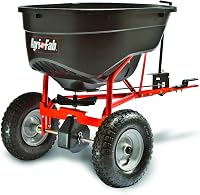
For larger yards, the Agri-Fab pull-behind has a 130 lb hopper and covers up to 1/2 acre or about 25,000 sq. ft. per fill. It spreads 10 ft to 12 ft wide and connects to most riding mowers and lawn tractors.
For paths, steps, and small patches, the Yhtpouqe handheld spreader holds up to 80 oz. It has three adjustable opening sizes and a screw top to reduce spills.
How to use Scotts fertilizer spreader settings with different products
Read the back of each Scotts bag for its own setting, then test before the full lawn. This is the part of how to use Scotts fertilizer spreader models that most people skip.
Write the setting on a piece of tape on the hopper for the current job. When you switch from fertilizer to seed or winter salt, change the dial and test again.
Our guide to how to use Scotts fertilizer spreader models covers the Scotts line in more depth. It pairs well with this guide if your spreader is a Scotts walk-behind.
If you are shopping for a fertilizer spreader, compare hopper size, spread width, and whether you need drop or broadcast delivery. Match those specs to your yard before you buy.
How do you spread evenly without stripes or misses?
Keep the overlap consistent and check the pattern on pavement after each rate change. Stripes usually come from uneven pace, late handle opening, or wrong overlap, not from the spreader itself.
Open the handle a step before your start mark and close it a step after your end mark only if your model requires that lead-in. Test on pavement to see where granules first appear and where they stop.
For a drop spreader for lawn use, overlap so the edge of one band meets the start of the next. Too little overlap leaves thin lines, and too much overlap creates dark green stripes.
If you switch to a broadcast model, even coverage needs a different technique. Our guide on how to use a broadcast spreader evenly explains the wider throw and the overlap needed for that style.
How do you clean and store a drop spreader after use?
Empty leftover material, rinse the hopper, dry moving parts, and store it indoors. Salt and fertilizer residue can cake, corrode metal, and clog the drop chute.
Shake or brush out leftover granules into a sealed container for the next job. Do not leave damp salt or fertilizer sitting in the hopper overnight.
Rinse with water, then dry the hopper and chute fully. Check the agitator or spinner area on broadcast models, and the drop plate or chute on drop models, for stuck granules.
Store the spreader upright in a dry spot. If wheels feel stiff or the handle sticks, clean and dry those parts before the next season.
For replacement parts, also check our guide to best seed spreader wheels if traction or rolling is poor.
What should you check if you are choosing a spreader for a small lawn?
For a small lawn, control matters more than hopper size. A narrow drop band, an edge shield, or a handheld model can save more product than a large hopper ever will.
Our guide to what is the best fertilizer spreader for small lawns compares options for tight yards. It is a good next read if your lawn is mostly borders, steep areas, or narrow strips.
Pick the Scotts EdgeGuard DLX if you want pre-calibrated Scotts setup and side blocking near hard surfaces. Pick the Agri-Fab pull-behind if you tow behind a rider and cover up to about 25,000 sq. ft. per fill.
Pick the Yhtpouqe handheld if you mainly treat paths, steps, and small patches.
How to use Scotts drop spreader models: final checklist
Set the rate, test the pattern, walk steady passes, close at turns, and clean the hopper. That checklist covers most of how to use Scotts drop spreader models without waste or stripes.
Before you start, confirm the product, the rate setting, your start marks, and your overlap plan. During the job, keep your pace constant and close the handle before you stop.
After the job, empty and rinse the hopper, dry the chute or spinner area, and store the spreader indoors. Those habits keep the next application even and extend the life of the tool.
Frequently asked questions
How to use Scotts drop spreader controls?
Set the rate control dial to the setting printed on your Scotts product, then open the handle only after you start walking. Keep a steady pace, close the handle before you stop or turn, and check the spread pattern on pavement first so you can see gaps or heavy lines before you treat the lawn.
What is the difference between a Scotts drop spreader and a broadcast spreader?
A drop spreader releases material straight down in a narrow band, while a broadcast spreader throws it wide with a spinner. Drop models give you more edge control and less waste on driveways, while broadcast models cover large open lawns faster with fewer passes across the yard.
Can I use a Scotts spreader for salt and ice melt?
Yes, some Scotts models are rated for seed, fertilizer, salt, and ice melt, and the EdgeGuard DLX is described for year-round use including winter. Rinse the hopper and spinner or drop mechanism after salt use, dry it fully, and store it indoors so residual salt does not corrode moving parts.
How do I avoid stripes when using a drop spreader?
Walk at the same speed on every pass, open and close the handle at the same marked points, and overlap passes by the amount your model requires. Mark your start and stop lines with flags or cones, and test the pattern on a driveway first so you can correct overlap before it shows on grass.